The Tiger’s Wife, Roz Chast, and Visits with Death

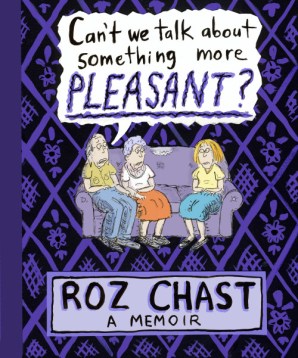
I had the great privilege to read an amazing graphic memoir this week. Can’t We Talk About Something More Pleasant? by Roz Chast, published in 2014.
Cant-We-Talk-About-Something-More-PLeasant-e1452888025962

In this graphic memoir (or “illustrated memoir,” in case that term is unfamiliar), Ms. Chast details the physical and mental decline of her parents, who both lived into their nineties. Her father died in 2007, and her mother died in 2009. The psychological and emotional demands of providing nursing care, and then hospice care, are examined in this book with great humor, compassion, honesty, and wit. It’s an amazing book.

Ms. Chast is an illustrator and cartoonist whose work has appeared in the New Yorker since 1978, and her artwork in this memoir is truly phenomenal. There were times I laughed so hard that tears streamed down my face, times when I could not stop giggling with that profound sense of — yes, someone gets it! I’m not alone! the tissues! the Fig Newtons! the sundowning! the love and the pain and the array of items to shop for in the adult care aisle, other people totally get this!! — and times when I was just deeply moved by Ms. Chast’s bravery in sharing her life with me, a stranger, who was awed by this beautiful gift of her memoir.

I read the book having never before heard Roz Chast speak in public, but after I finished the book, I watched this video of Ms. Chast giving a reading at Politics & Prose, a Washington, D.C. bookshop that is sometimes mentioned on the PBS NewsHour —


If you’re curious about what the interior pages of Can’t We Talk About Something More Pleasant? are like, this video will give you a bit of the flavor of this brilliant memoir.

The central dilemma, for Ms. Chast and her parents, as well as for most people (like, 99.99% of us) — is that no one likes to talk about death.

Death, death, death.

The big, looming nothingness that faces us all.

Big, looming —

SCARY!!!!!

Death is SCARY!!! Ahhhhh!!! Run away, run away!!!

Even people who are confident they are headed to a gorgeous Paradise of the Hereafter once they die — even these people do not like to talk about Actually Dying.

And if you write literary fiction, then it’s pretty much a Rule of the Universe that death has to be the Big Bad of the story — the central terror of the tale — the looming crisis that drives everything. In literary fiction, the characters fear death — because what is more scary than death??

death_rides_a_pale_trike_by_mjranum_stock

Well, there is also the fear that talking about “bad things,” like Death, will make them contagious. I think that fear is oftentimes equally strong. People have this strange, seldom acknowledged terror of “bad things” going airborne and spreading like viruses.

134511-134329

While it IS true that the company you keep has a powerful influence over you (for instance, hanging out with gang-bangers can often lead to gang-banging) — it is not true that discussing topics like cancer, gangrene, and epilepsy will lead to more cancer, gangrene, and epilepsy.

And yet, we all have this unspoken, unconscious avoidance of “bad things” because they might be contagious, in the same way most of us avoid gang-bangers. Maybe not all of the time, but sometimes, for all of us, I believe this is true.

Anger, rage, fury, resentment, self-righteousness — “bad attitudes” can certainly be contagious. Cancer, gangrene, and epilepsy, fortunately, are not. Humans, however, being the emotional, irrational creatures we are, oftentimes fail to separate such things in our minds. Including me. I’ve suffered through a lot of denial and avoidance in my life. It’s ugly. Then again, I never turned into a gang-banger, so at least there is that.

But let me get back to Death, and the fact that most people fear Death, which translates into the fact that most people don’t like to talk about Death.

Which also means that a lot of people don’t like to talk about Aging. Because Aging is the warm-up of Death, so Aging is often as terrifying as the eternal nothingness of the end.

That was what Roz Chast — and most of the rest of us — face when we are confronted with aging and death — people don’t want to talk about it, because they are scared, and that makes dealing with it — or navigating through the challenges of caregiving — more difficult.

Which means that the subject of aging and death, as I have already mentioned, makes for great material in fiction.

That brings me to the 2010 literary novel The Tiger’s Wife, by Téa Obreht, which won the British Orange Prize for Fiction in 2011.

I first read this novel in 2010, and I reread the book this month, and discovered I had a lot to say about the novel now, especially having read the book in tandem with Can’t We Talk About Sometime More Pleasant?

71rwUr429aL[1]

Quoting the gist of the plot from Wikipedia, The Tiger’s Wife is set “in an unnamed Balkan country, in the present and half a century ago, and features a young doctor’s relationship with her grandfather and the stories he tells her. These concern a ‘deathless man’ who meets him several times in different places and never grows old, and a deaf-mute girl from his childhood village who befriends a tiger that escaped from a zoo.”

The deathless man is not a vampire — he doesn’t kill people in order to keep himself alive — he just cannot die. His name is Gavran Gaile. His lack of being able to die was actually a punishment from Death himself, who is Gavran’s uncle.

(Anyone who hasn’t yet read The Tiger’s Wife, and would prefer not to read spoilers, should stop reading this post right now, because spoilers abound.)

Why did Death need to punish his nephew?

Because Gavran prevented a young woman from dying. He had fallen in love with this woman, and they ran off together. Then the woman grew fatally ill again, and once again Gavran took action to keep her alive — and this pissed Death off FOREVER. The young woman died, and Gavran was cursed with eternal life, thereafter becoming the deathless man.

After this sad twist of fate, Gavran meets a young Balkan man working as a doctor, and over the course of several decades, they continue to meet in random places, and the doctor grows older and older while Gavran stays the same age, and then one day, the doctor dies. But while the doctor was still alive, he told his granddaughter all about the deathless man, and she loved her grandfather so much that she decided to be a doctor just like him.

And so, the “young doctor” narrating the book is named Natalia, and we know how much she loved her grandfather because, after his death (in 2009 or so — the grandfather dies in “the present day” of the story), Natalia goes to her grandfather’s childhood village and learns about the tiger’s wife, a story that the grandfather had never shared with Natalia. Natalia discovers this story only after he dies, motivated to learn why he was obsessed with watching the tigers at the zoo all his life. Natalia is like, Hmmm… what is up with my grandfather’s obsession with these tigers? He always told me that fascinating story about the deathless man. Maybe I’ll go to Grandfather’s childhood village and ask around.
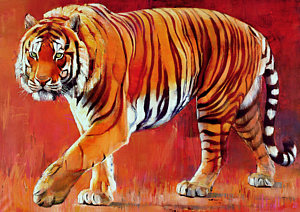
bengal-tiger-mark-adlington

That’s the central crux of the novel — Natalia knows the story of the deathless man from her grandfather. But she doesn’t understand why he went to the zoo every day to stare at the tigers. So she journeys to her grandfather’s childhood village after he dies, and learns the story of the tiger’s wife, which her grandfather never shared with her.

The story of the deathless man and the story of the tiger’s wife are strongly linked together — even though Natalia doesn’t spend time discussing this link for the reader. It’s a link you discover for yourself in the book, and you have to draw your own conclusions about it.

Which is what I’m doing in this blog post. *Spoilers abound.*

The woman Gavran Gaile gets in trouble for keeping alive is a young Muslim named Amana Effendi, and while it isn’t clear whether Amana is a practicing Muslim, she was born to a Muslim (“Turkish”) father, and that IS made clear.

As a young woman, before Amana meets Gavran, we are told she does not want to ever get married or have children. She’s also living way back in ye olden days, circa 1930, which is not that different from today, when a woman’s failure to marry and bear the fruit of her womb is like, Oh My Gawd Da World Be ‘A Comin’ to an End!! Because what is the point of “being a woman” unless you bear children?

Amana’s dad isn’t super happy about his daughter’s “I don’t need a man” attitude, but he laughs and jokes about it with all his pals, ’cause he has the kind of money that allows him to laugh and joke about being stuck with an unmarried daughter — i.e., a permanent “mouth to feed” in his household — which is no laughing matter, not in ye olden days, and not today, either.

Then Amana meets a young man named Luka, who grew up getting the sh*t beat out of him by his father, a butcher, so Luka fled to the city so he could write songs and play the gusla.

When I first read The Tiger’s Wife, way back in 2010, I had no idea what a gusla looked like.

Rereading the book this month, in 2015, I have the advantage of Wi-Fi. So I can show you a picture of a guy playing a gusla

882e808c6fdd8c64304a91e971659e31

It’s this traditional Balkan musical instrument with like, one string or something (at least, that’s what it says in The Tiger’s Wife), and Luka writes beautiful music and plays his one-stringed gusla really well, and he and Amana start to sing together and become friends.

Not sexual friends, because Luka is gay and Amana doesn’t want anything to do with the whole love-sex-marriage-babies thing. She’s adamant to remain a virgin. Amana and Luka are platonic buddies who sing and make music together, and they do this until Luka finds out the following three things —

1. His father is dying.

2. His father is in need of someone to take care of him.

3. His father has an inheritance to leave behind.

In order for Luka to gain his inheritance from this child-beating sh*thead, Luka decides he should marry Amana (who he will never have sex with, thus maintaining her lifelong vow of virginity), then he’ll take her home to his backward Christian village of peasants (where his a-hole father lives), take care of his dad till the old man kicks the bucket, and then Luka can take his inheritance money and move to the city. In the city, Luka plans to be a famous musician and maybe open a music school and do other stuff with his passion for playing the gusla.

Then — suddenly! — Amana falls deathly ill (oh no!). She is locked away in her room right before she and Luka plan to marry and go off to the backward village together.

Gavran Gaile, nephew of Death, pays a visit. Gavran is known to visit the bedsides of those who are deathly ill, to let them know whether they will die or recover from whatever ails them.

Gavran and Amana fall in love. (Plot twist!)

Amana doesn’t know what to do!

So she turns to her deaf-mute sister, who comforts her.

Then Amana runs away with Gavran, and her Muslim father takes the deaf-mute sister, who is maybe 14 or 15 years old, covers her face with a veil, and marries her off to Luka instead.

Luka doesn’t know he’s marrying the deaf-mute sister until after the vows are recited, the veil is lifted, and he’s all — wait, that is NOT Amana!

Only now it’s too late!!

They are married.

Poor Luka!

He goes home to his backward village, to live with his a-hole abusive father. Only now he is taking along a deaf-mute for a wife, whose name he does not even know.

Poor Luka!

His dad starts sexually abusing the deaf-mute wife, so Luka doesn’t run off to the city as planned. He stays in the backward village with his a-hole dad. To try to protect his wife from being raped nonstop.

Poor Luka!

(Because that is why we are told Luka’s backstory — to have compassion for him. He just wanted to be a gusla player, sing songs, and make music. And he would have, if not for Amana — because on the day Luka met her, “he met the woman who would destroy his life” [page 199]. Because women ruin *everything* — obviously. Damn women. Poor Luka!)

In staying in the backward village, and working as a butcher, living with his a-hole dad once again, Luka SNAPS.

One day, Luka’s RAGE against the INJUSTICES of his life (the lies! the trickery! the betrayal!) explode out of him, and he starts to beat the f*cking sh*t out of the deaf-mute girl he was forced to marry.

Poor Luka!

He became a rager and wife-beater, just like his old man. Poor Luka!

No more gusla-playing for him! His dreams have been dashed. And it is ALL the little deaf-mute Muslim girl’s fault! Bring on the violence! The smashed bones! The snapped teeth! The cracked skull! Beat that girl till she’s asleep for days on end, suffering with a concussion, clinging to life — because THIS is ALL HER FAULT.

The backward villagers know Luka is beating the f*cking sh*t out of his wife, but they do nothing, of course. No one meddles with a man’s personal business.
See_No_Evil,_Hear_No_Evil,_Speak_No_Evil

So, the reader is left to wonder on her own —

If Gavran Gaile had never cheated his uncle, and kept Amana alive — maybe Luka would not have been forced to marry the deaf-mute sister instead.

And then maybe the deaf-mute girl would never have been beaten and beaten and beaten by Luka (poor Luka! with all his dashed hopes! all his lost dreams! poor Luka!) because if Luka’s hopes and dreams had never been lost by Amana’s betrayal, the deaf-mute girl would never have gone to live in the backward village full of misogynist, Muslim-hating a-holes.

But, because Gavran cheated Death, kept Amana alive, and ran away with her, Luka was tricked into marrying Amana’s deaf-mute sister instead, and that deaf-mute girl ends up living in a backward Balkan village full of people who are predominately a bunch of misogynist, Muslim-hating a-holes.

Das_Dorf_Janc_e_im_Nationalpark_Mavrovo-w820-ar

In that village, the deaf-mute girl ends up meeting an escaped tiger living wild in the woods. The tiger’s zoo was bombed, and the tiger ran away into wilderness, and then the scent of the deaf-mute girl drew the tiger to her, and the tiger comes to see her every day after sunset. No one knows about these visits. At least, not at first.

One day, Luka beats his wife (just like always!), and then ties her up outside all night, in the hope that she’ll die and he won’t have to be a rager anymore. (Poor Luka!)

But somehow, his wife gets free. (Maybe the tiger frees her!)

And somehow, Luka disappears. (Maybe the tiger killed him! No, I’m just kidding. The narrator — Natalia — believes the deaf-mute girl shot him in bed, after she freed herself from her bonds. But that is Natalia’s projection, not a known fact.)

Once Luka disappears, the backward villagers decide that the deaf-mute girl killed her husband, and that she now spends her nights with the tiger — a demon they’re trying to kill. Then she ends up pregnant, either from Luka raping her (before he died), or one of the backward villagers raping her. So the villagers rename her “the tiger’s wife” — and this brings me to my favorite lines in the book, lines of dialogue spoken by one of the backward villagers (on page 225 in the hardback copy) —

“Point is, that tiger come all the way up to the door of Luka’s house, and then he get up and take off his skin. Leaves it out on the step and goes in to see his pregnant wife.”

M31b68c3d9acecbebf584de0e86e19933[1]

And this is the heart of the book.

A deaf-mute child who is misunderstood, hated, and abused, who loves and is loved by a ragged, forlorn tiger, an animal that is also misunderstood, hated, and abused. Both the girl and the tiger are targeted for destruction. The backward villagers, in their misogyny, Islamaphobia, and fear of the unknown, decide they must kill the girl and the tiger.

Because really, what those villagers fear are their own deaths. So, like Luka with his raging violence, lashing out in rage becomes the answer.

The tiger is killed by a traveling middle-aged man known as Darisa the Bear, who grew up so terrified of death that he became a taxidermist, and then a murderer of bears (so he could taxidermy the dead ursine bodies).

Darisa kills, and is killed by, the tiger. (Though we never see the tiger’s dead body. We just know that the tiger is shot. We also never see Darisa’s body. We just know all that was left of him was a lot of blood on the snow.)

The man who kills the deaf-mute pregnant girl is the village apothecary, a man who escaped death by hiding the fact that he is a Muslim. (We don’t know if he was a practicing Muslim, but he was born with the name Kasim, which he changed as a young boy.) To survive in the village, no one knew the apothecary was born a Muslim, because those Islamaphobes would have killed him, the same way they target the deaf-mute Muslim girl for destruction.

How does the apothecary kill the deaf-mute girl? With poison. He gives a bottle of poison to her only friend in the village, the only person who ever showed the girl kindness — a nine-year-old boy who is too young and too innocent to understand misogyny or Islamaphobia. The apothecary, who always seemed like such a nice, helpful guy before, now tells the boy that the poison is to help the girl with her baby, so the boy goes off to see her, and helps her drink the elixir of doom.

That boy is Natalia’s grandfather.

20-poison-jar[1]

Later, when Nazi troops roll into town, the apothecary is hung. It’s not clear why the Nazis kill him, but the moment of his death is given a lot of weight in the story.

The Nazis, of course, are one of the greatest emblems of death in all human history.

And what else were the Nazis, but a nation full of self-righteous rage lashing out?

What else was Hitler, but a man who was so terrified of Death that he massacred millions to prove he was the one still alive?

These aren’t questions the novel asks, or provides answers to. But it’s hard not to read The Tiger’s Wife any other way, if you’re reading carefully, if you take all these small vignettes and connections woven throughout the story, and draw them out into your own larger conclusions.

Of course, by the 1990s, once Natalia is born, Yugoslavia exploded with violence. All that Islamaphobia and misogyny and self-righteous rage erupted into the large-scale rape and massacre of thousands upon thousands of innocents in a brutal civil war — and that is the world Natalia grows up in, listening to the tales of the deathless man from her grandfather, who has an abiding fascination with tigers.

As a young man, Natalia’s grandfather married a Muslim woman. They had one child together, a baby girl, Natalia’s mother. And though the book doesn’t say this, the reader has to assume that the grandfather’s childhood friendship with the deaf-mute Muslim girl, who he unwittingly helped to murder — surely, that relationship played into his later decision to marry a Muslim woman himself.

p01l6j53

The Tiger’s Wife isn’t a story about heroes. Or triumph. My heart and emotions weren’t bound up with Natalia, or her grandfather, or Natalia’s friend Zora, or the modern-day villagers digging up a hillside looking for a mis-buried body. No one in the modern world of the novel interested me.

The grandfather himself was as insecure about death as anyone. As a young man, he reacted with anger and denial to Gavran Gaile’s tale about being Death’s nephew. It took seeing Gavran’s lack of aging (over decades) for the grandfather to believe the deathless man’s stories were true. To me, the grandfather came across as a white, Christian, privileged crank, calling people fools and seething with a low-level fury, which is a huge sign of insecurity. And his insecurity, of course, is driven by fear of death.

Even once the grandfather was old, and was diagnosed with cancer, he didn’t tell anyone but his granddaughter that he was sick with “an illness he hid like shame” (page 333). Which, of course, means that the grandfather was still afraid to die.

The only two creatures in the novel who had any kind of power to move my heart, or make me feel anything, were the tiger and the tiger’s wife, who have a bond and connection with each other that is stronger than fear, and therefore, stronger than death, and it is their fearlessness which makes them more eternal than Gavran Gaile (whose biological immortality is a curse).

In The Tiger’s Wife, death is a gift — but it is a gift that scares people. Scares people so much that, to hide their deep insecurity, they rage and lash out, destroy women, and animals, and then themselves. Wars and civil wars are all motivated by that deep-seated terror of death. In war, soldiers die, but so do civilians. Adults die, but so do children. Murderers die, but so do the innocent.

The Tiger’s Wife is a long meditation on the nature of death. The extent that we fear it, and how far we will go to try to push it away.

It’s also a novel in which every vignette and tangential aside in the book is a story of death. Death is the theme of this book. Death and destruction. The story of the tiger’s wife is a story of Death. The story of the deathless man is a story of Death. Ditto Natalia’s life. Ditto war. Ditto Darisa the Bear, and the apothecary, and all those ignorant, backward Christian villagers. Everything that came out of their mouths was something related to Death — their ignorance grew from fear, and their fear sprang from death.

See this picture I found online of a cupcake?

cupcakes[1]

Well, guess what? That cupcake is about DEATH.

I know what you’re thinking right now. Yes indeed.

“Can’t we talk about something more pleasant?

Why, yes. Yes we can.

As long as you know that, no matter what story you tell, you’re really talking about death.

Even when you look at a cupcake.

Unless, of course, you’re not afraid to die.

In which case, that cupcake might be just a cupcake.

And innocence might still be alive. Along with the tiger. And his wife.

girl-with-tiger-cub

Posted in My Thoughts | Leave a comment

Reflections on Amy Winehouse: The Movie, the Woman, Her Music

Amy Winehouse was born in 1983 — three years after I was born — and she died on July 23, 2011. She was found alone in her bed, dead of alcohol poisoning. Basically, I think, her heart just gave out. She was 27 years old.

555a4c211aaec7043ea4d55f_t-amy-winehouse-cannes-film-festival-2015[1]


In the years that Amy Winehouse was gaining in popularity, I was far, far removed from the world of pop culture. I lived in a tiny mountain town called Ouray, and I didn’t have the money for internet access. For six full years after I graduated from college, I didn’t even have an email address. To my 35-year-old self, that just seems insane.

In 2007, when I started teaching first grade, my life was further insulated from all things “hip” and “cool.” What I knew of the outside world came from the radio, which I listened to on weekend trips to Montrose for groceries. NPR and pop music were the extent of my pop culture knowledge. The PBS NewsHour wasn’t yet doing segments like “NewsHour shares,” or those snippets of trending information on Twitter, the way the program does now.

Thus was the state of my life while Amy Winehouse was busy making her music and becoming super famous all over the world.

amy-winehouse[1]


In the summer of 2011, when Amy Winehouse died, I really knew nothing about her. Her massively overplayed “Rehab” song got on my nerves. It wasn’t a song that had ever appealed to me, since I felt the lyrics glorified the ugly aspect of denial in addiction, and drug and alcohol addiction has taken such a serious toll in my own life, I can’t revel in the destructiveness of denial. The fact that “Rehab” was overplayed inspired instant change-the-station mode whenever I had the radio on.

As to her other music — well, I just had no exposure to it. I was extremely isolated to world events unless said world events were discussed on the PBS NewsHour. To my knowledge, Amy Winehouse’s hit singles weren’t making the cut of serious happenings for the PBS NewsHour.

So this is what I thought of Amy Winehouse in 2011 — that she was “just another” rock star making tons of money by creating music that celebrated drug and alcohol use, by writing and singing lyrics taken from her own life of abusing drugs and alcohol.

I didn’t see her as unique. I saw her as just another money-making machine, like the cast of Jersey Shore and those other MTV reality shows.

amywinehouse4[1]


When the radio airwaves filled with news of her death in July 2011, I wasn’t surprised, and I didn’t have any reason to care she was dead. To me, she was just one more person in the world who’d been sucked into the appeal of booze, powders, and pills to take away pain and solve problems — and while I do have compassion for addicts, I don’t see the point in wringing my hands and stressing myself out when their lives are cut short by addiction. I just feel like, “Now they’re in peace, because death has freed them from the overwhelming, compulsive desire to get their next fix. Now they’re free of the pain that drove them to abuse drugs and alcohol.”

Which might sound cruel to some people. Maybe compassion would best be served by all the hand-wringing and sobbing and “oh my God, what a tragedy!” wails of lament. I don’t know. I already have so much stress in my life, that stressing out because drug addicts “should not die young” when the reality is, they can and do die young every day — embracing that kind of stress feels futile to me. Yes, people live more enriching, rewarding lives when they are free of addiction. But this knowledge does not stop people from becoming addicts, because addiction is driven by pain, and telling someone how to respond to pain is much like telling them what they should eat every day, or how they should parent their children, or what car they should buy — no one likes to be told what to do.

So unless someone comes to you asking your advice, dictating lifestyle choices to adults is unwise, as most often, you are being tuned out. Like me changing the station when “Rehab” came on.

Amy-Winehouse[2]


After 2011, Amy Winehouse did not come up in my life again until December of 2014, when I read Roxane Gay’s brilliant collection of essays, Bad Feminist. I blogged about that book at the end of December, and while I touched on some of the topics that had a big emotional impact on me in that book, one topic I didn’t mention was Ms. Gay’s discussion of the life of Amy Winehouse.

It was the first time I’d ever read something moving about the life of this young musician, words that honored her and made me think of her as much more than just some young star in the limelight celebrating addiction.

Ms. Gay discusses Amy Winehouse near the very end of her book, in an essay titled, “Tragedy. Call. Compassion. Response.” It’s a beautiful essay, one that also discusses the July 22, 2011 bombing of Oslo, Norway’s government headquarters, by Anders Behring Breivik, an atrocity that killed seventy-seven people.

Ms. Gay’s description of Amy Winehouse’s death, a death which took place the day after the bombing in Oslo, deserves to be quoted at length. This passage begins on p.298 of my paperback copy of Bad Feminist, and I follow it through to the end of the essay —

amy-winehouse[1]


“There is a girl who was a woman, but really, she was a girl. She was a girl because she was only twenty-seven, had only lived a third of a life. She had a voice like fine whiskey and cigarettes, or at least what I imagine fine whiskey and cigarettes might sound like. She had a voice that made me think of dark, secret nightclubs where you need to know a guy to gain admittance, where musicians gather closely on a small stage and play their instruments for hours in a haze of sweat and cologne, booze and smoke, while a singer, this girl-woman singer, stands at the microphone, giving those gathered the exceptional gift of her voice.

“The year her second album came out was the year of the Halloween dedicated to this girl-woman. Everywhere I looked, women and some men wore their hair (or a wig) long and black with a bouffant on top, and they lined their eyes blackly with that distinctive angle at the corner of each eye, and they drew tattoos on their bare arms and sang the chorus of her most popular song. They tried to make me go to rehab. Call. I said, No, No, No. Response. That’s why we care. She was in our lives and our ears and our heads and our hair.

“The girl-woman singer died in her flat, alone in bed. Too many people said, “It was to be expected,” because we knew this girl who was a woman was really a girl. We knew she had problems, and she did not have the luxury the rest of us do to handle our problems privately, with dignity. She was a mess. So what? We are all stinking messes, every last one of us, or we once were messes and found our way out, or we are trying to find our way out of a mess, scratching, reaching. We knew she had demons that were bigger than her, demons she tried to fight or she didn’t — we can’t possibly know. Her struggles were documented and parodied, celebrated and ridiculed. Celebrity. Call. Gossip. Response. We have seen the pictures of this girl-woman in the street, barefoot, her midriff bare and swollen, her makeup smeared, her unforgettable hair stringy, pasted to her pale face, her body being carried from her home in a red body bag. There was no privacy for her, not even in death. That is tragedy too.

“I love her music and listen to it regularly. I always hoped she might survive herself, hoped she would give her adoring fans more of her voice, hoped she would give herself the blessing of a long life. I heard she died from my best friend, who sent me a text message, and we commiserated about what a shame it was for a girl-woman to die at the age of twenty-seven. It is a different kind of devastating to think about the life she will never know, about those gifts that come with more years of living. I do not wonder about the cause of her death. The how of her demise isn’t my business. And yet. When I first heard of her death, I wondered if she died alone. I wondered if she was scared. There is fear and there is fear. Now, I wonder if she knew real happiness in her short life. I wonder if she felt loved or knew peace. She was someone’s daughter. She was someone’s sister. We know her father found out while he was on a plane. He did not have any kind of privacy to make sense of surviving his child. The death of a child is unbearable and suffocating. After Amy Winehouse’s death, her parents had to try to cope with something the human heart is ill equipped to withstand. Tragedy. Call. Broken heart. Response.

“I followed many conversations about what happened in Norway and the death of Amy Winehouse because they happened one right after the next. Too many of those conversations tried to conflate the two events, tried to create some kind of hierarchy of tragedy, grief, call, response. There was so much judgment, so much interrogation of grief — how dare we mourn a singer, an entertainer, a girl-woman who struggled with addiction, as if the life of an addict is somehow less worthy a life, as if we are not entitled to mourn unless the tragedy happens to the right kind of people. How dare we mourn a singer when across an ocean seventy-seven people are dead? We are asked these questions as if we only have the capacity to mourn one tragedy at a time, as if we must measure the depth and reach of a tragedy before deciding how to respond, as if compassion and kindness are finite resources we must use sparingly. We cannot put these two tragedies on a chart and connect them with a straight line. We cannot understand these tragedies neatly.

“Death is a tragedy whether it is the death of one girl-woman in London or seventy-seven men, women, and children in Norway. We know this, but perhaps it needs to be said over and over again so we do not forget.

“I have never considered compassion a finite resource. I would not want to live in a world where such was the case.

“Tragedy. Call. Great. Small. Compassion. Response. Compassion. Response.”

*****

Those words resonated with me, and when I discovered a film had been made about Amy Winehouse, I was eager to read the review by Manohla Dargis. Published on July 2, 2015, Amy: An Intimate Diary of Amy Winehouse’s Rise and Destruction convinced me that this was a movie I needed to see.

So on Saturday, August 15, I went to see a five o’clock showing of Amy here in Durango. And I’m really glad that I did.

biografia-Amy-Winehouse[1]


I learned so much about Amy Winehouse. I discovered how funny and smart and charming she was. I learned about the people who genuinely loved her, and the people around her who used her, who fed on her like vampires. I learned about a young woman who put her faith in her father, and her lover, and then suffered the consequences.

To fail to stand up for yourself, and your own desires, is ultimately a failure of the self. Something inside has been allowed to be crushed — and drugs and alcohol soothe that crushed thing. This movie exposes the audience to the crushed thing inside Amy Winehouse, and the people who continued to draw blood from her body, long after it was clear she needed help. When I heard her sing “Rehab” in this movie, my heart broke — a clean, crisp break, a sound like snapping open a glass vial of morphine. That was what I heard in my chest when the lyrics of “Rehab” appeared on the screen, because they signaled the beginning of the end of this young woman’s life.

The most beautiful part of this film is seeing Amy Winehouse navigate her pain in her lyrics — words that are displayed alongside her as she sings — and it’s a truly brilliant piece of film-making, watching Amy’s life recorded in diary form in her haunting music.

And it is beautiful music. I especially love this song, “Back to Black” —


For whatever reason, but most likely due to my lack of social media savvy, I’d never heard that song before I saw the film Amy.

The song “You Know I’m No Good” is also really amazing —


Odd as it may seem, I do mourn Amy Winehouse now, after seeing this movie. She was not a perfect person. She was deeply flawed.

But wow, she had talent. And drive. She also had a quick mind, and she wrote really, really beautiful lyrics. Starting as a child, she suffered from bulimia — a condition she carried with her until the day she died. Her skinny arms and legs came at a steep price. My heart breaks for anyone with an eating disorder — and Amy’s bulimia definitely contributed to her early death.

And wow, was the paparazzi vicious!! Those flashing, snapping cameras being shoved at Amy Winehouse are like watching rabid sharks ripping into her — it’s horrendously abusive. She needed more body guards or something, those a**holes were out of control. The corporate celebrity machine is disgusting — and the brutality of this constant assault led to the most haunting lines near the end of the film.

None of the video footage was created for the movie — everything shown in Amy was filmed while she was alive, and everyone connected to her is allowed to speak for themselves, including her father, her lover(s) and husband, and her friends.

This is definitely a worthwhile picture to see. Amy will make you think about what it means to be human, to be an artist, to let the people you love turn you onto heroin and crack, what happens when you put your trust in the wrong people, and what it takes to survive in the ugly, brutal world of being famous.

Posted in My Thoughts | 4 Comments

Tough Reading: The Sixth Extinction: An Unnatural History

In July, I read a book that changed my life.

The Sixth Extinction: An Unnatural History, by Elizabeth Kolbert. Published in 2014.

This book was one of The 10 Best Books of 2014 as listed by The New York Times, which is how I discovered the book. I’ve been doing research on ocean acidification for my current work in progress, a Young Adult fantasy novel, and I knew right away that reading this book would be helpful.

Sixth-extinction-nonfiction-book-kobert[1]


This is a nonfiction book about climate change, ocean acidification, and the human-caused mass extinction event currently taking place. The book is extremely well-written, full of accessible scientific information and facts. And it’s one of the most gripping, horrifying, deeply moving, and powerful books I’ve ever read in my life.

The book has sent me into the horrors our planet is facing due to global warming — and things are very grim indeed.

Jon Stewart interviewed Elizabeth Kolbert about her book on The Daily Show in February 2014. Of course, that interview makes me smile, but it is gallows humor, and I certainly have tears to go along with my smile.

tumblr_inline_n0wesjsZnt1rl2d09[1]


In fact, I bawled like a blubber-walla through much of this book. Just thinking about how much crying I’ve done in the past four weeks while reading The Sixth Extinction inspires more tears. Some sections, I read aloud to Greg while we were driving to Utah, and while we were camping. But I would choke up so bad and start crying, that I couldn’t continue. This is not a book I could ever read aloud without stopping to cry.

Greg is worried about me. He thinks it’s dangerous to dwell on what’s happening to the planet because we’re not taking drastic, global action on climate change. He’s worried about my psychological health. I’m just worried about the planet. The planet, humanity, and all of the lifeforms going extinct, as we carry on with business as usual.

The Sixth Extinction did such a number on me emotionally, that it took me three extra weeks to finish reading this amazing book —

6200541[1]


The World Is Blue: How Our Fate and the Ocean’s Are One, by Dr. Sylvia A. Earle. Published in 2009.

This book covers similar territory as The Sixth Extinction — but there is no overlap of information. Each book is completely distinct, and reading them together deepened my understanding of climate change issues considerably. I feel like I’ve been rocketed off “planet blindness” in more ways than one, and I now live on “planet in massive trouble with a dwindling window of hope.” There is no going back.

How have I changed?

Awareness. Awareness and a sense of urgency.

For example, I drive a 2010 Prius hybrid, and I’ve spent hours and hours these past few weeks trying to figure out if I can trade in my Prius for a zero emissions vehicle. In the end, the answer is no, it’s not currently possible for me to trade in my greenhouse-gas emitting Prius for either a hydrogen car or an EV (electric vehicle). I can’t even get a plug-in Prius hybrid, because those have all been shipped to California. California just passed a measure allowing plug-in Prius hybrids access to the carpool lane, which means the California dealerships quickly swept up all the plug-ins left on the market. So those cars are selling only in California now, for $2,000.00 above the full retail price.

I cannot drive from Colorado to California and back to purchase a car. Nor can I afford to spend $80,000.00 to $100,000.00 on a Tesla. Spending money like that on a vehicle is not the sort of reality I have ever lived in.

But I tried. There is nothing wrong with my Prius, but for the sake of cutting my greenhouse gas emissions, I tried to get an EV.

After my camping trip, I spent hours walking the highway by my house, picking up garbage, 98% of which I was able to recycle. After reading The Sixth Extinction, this was just something I needed to do — just get out there and do something. Now.

And then there are other effects, which are like aftershocks that continue to resonate in my head. I can’t walk into a store and think about buying *anything* now without first thinking about the packaging container it comes in — namely, if I can recycle it or not. If I can’t recycle it, I don’t buy it.

I wasn’t always this way. A big recycler, yes, I’ve been that way since before high school. Now I’ve just become more extreme.

If I could shop at this zero-waste grocery store in Germany, I totally would.

I’m currently reading this book —

thischangeseverything398x425_0[1]


This Changes Everything: Capitalism vs. the Climate, by Naomi Klein, published in 2014.

This book is so amazing. Unlike The Sixth Extinction, This Changes Everything is full of hope — but it’s a hope that comes with the awareness and urgency of “planet in massive trouble with a dwindling window of time left to save it.” It is that kind of hope.

Each one of these books deserves its own blog post, and I’m sorry I’m discussing them altogether like this. All three of these books are vital reads, each inspired by initially reading The Sixth Extinction.

After reading The World Is Blue, I joined Dr. Sylvia Earle’s mailing list for Mission Blue. I now read all of her newsletters, follow her on Facebook, and sign every online petition I can to help her create “Hope Spots” — or completely protected areas — in the sea. In the past six years, she has more than doubled the amount of protected marine environment in the ocean — which is still only less than three percent of the total area of the sea.

Still, it’s significant. Dr. Sylvia Earle is such an amazing human being, such a mighty real-life goddess, a scientist and conservation warrior — (oh man, here I go with my tears again!) — I’m overwhelmed with awe, gratitude, and amazement that this woman, who was born in 1935, is out there crusading every day to help save planet earth.

Here is her TED talk about creating Hope Spots, a beautiful speech that is transcribed at the end of The World Is Blue

https://embed-ssl.ted.com/talks/sylvia_earle_s_ted_prize_wish_to_protect_our_oceans.html


And here is Naomi Klein explaining why the recent U.S. EPA guidelines (rolled out earlier this month) to cut carbon dioxide emissions (largely from burning coal) is not enough to help climate change, as well as what sort of action might actually help, at this late hour, before we reach the point of no return on global warming —


All of this has had such a huge impact on me — psychologically, emotionally.

Facing the reality of what global warming means to our planet in the next few decades has led me into the same mental terrain I occupied when my grandmother died, when my aunts died, when my father died, when my uncle died. Except this is not my personal loss, or a family loss, or a community loss — but a global loss — a huge mass extinction — and it looks like, along with the coral reefs and polar bears and rhinos — human beings might not survive. Civilization as we know it will collapse. Rising oceans will sink many island communities and thriving port cities (like Boston and NYC), leading to the biggest human migration ever. Rising temperatures, droughts, and raging storms will destroy crop output, leading to mass starvation.

This is not science fiction. This is science. This is what the data is showing.

This future may be coming by the end of the century. Maybe sooner. Some scientists believe the nightmare is much, much closer than most people dare to realize.

To face this level of horror is difficult, but it is also necessary. An earth full of catastrophe and death might be the world we’ll be leaving our children. Our grandchildren.

Unless we act now. The window of opportunity is closing. And quick.

If I sound hysterical, well, so be it. In The Sixth Extinction, Ms. Kolbert writes about Paul Crutzen, “a Dutch chemist who shared a Nobel Prize for discovering the effects of ozone-depleting compounds. The importance of this discovery is difficult to overstate; had it not been made — and had the chemicals continued to be widely used — the ozone ‘hole’ that opens up every spring over Antarctica would have expanded until eventually it encircled the entire earth. (One of Crutzen’s fellow Nobelists reportedly came home from his lab one night and told his wife, ‘The work is going well, but it looks like it might be the end of the world.'” (p.107)

That’s what reading The Sixth Extinction, The World Is Blue, and This Changes Everything is like — these books are full of brilliant, noble people who are sounding the alarm, doing everything they can to create dramatic change, and save the planet — but it still looks like it might be the end of the world. The ozone ‘hole’ of global warming is growing every day, and once we hit the tipping point — which is coming up very soon, we’ll be going down with the planet.

Of course, I am a writer — my power of hope is in the stories I pen — and everything I’m feeling right now, my sense of urgency, my crisis, my pain — that is being channeled into my next book. It took me a while to be able to think rationally about climate change, but each day, I get closer to being clear-headed and lucid about the end of the world.

I’m also hoping to finish a short story for Glimmer Train before the end of the month. I have an idea about how to channel everything I’ve learned these past few weeks into a (horrifying) piece of literary fiction — I just have to put in the hours of work, to see if I can accomplish the task. To publish in Glimmer Train has been a huge dream of mine for years, and I would *love* to write something good enough to be accepted by that esteemed journal. I would love even more to write something about climate change that was worthy of publication.

I walked a lot of miles this week, reading books about global warming. I’m very, very thankful that I did.

Posted in My Thoughts | 1 Comment

The Big Tiny: Attachments, Possessions, Inspiration, and Gifts

I’ve had a book on my To Be Read list for almost a year now (since last November), when the author came to Durango to speak.

Her name is Dee Williams.

15723135-mmmain[1]


And she wrote a book called The Big Tiny: A Built-It-Myself Memoir.

51RPtn8B5uL._SX324_BO1,204,203,200_[1]


Ms. Williams is 50 years old this year, and this book was published in 2014, when she was 49. She grew up on a farm in Missouri, and moved west as an adult, so she could climb mountains and kayak and participate in all kinds of fun outdoor sports, which she did, all through her twenties and thirties. She ended up living in Portland, Oregon, where she bought a rundown house for $200,000.00, and in between house projects and building kayaks and having fun with her friends, she had different government jobs (teacher, chemical waste inspector) that paid very little. But, like a lot of fun-loving people who make very little, she pushed herself hard to make it all work.

While she was in Portland, at age 40, Ms. Williams collapsed, spent several days in the hospital, and was diagnosed with a heart condition. She had to get equipment installed in her heart muscle to keep her ticker thumping correctly, and she also had to face her mortality in a big way. Like someone diagnosed with cancer, death appeared at the window, and Ms. Williams couldn’t laugh and run away and forget that one day, maybe one day quite soon, she was going to die. Death was in her life now, standing there on the other side of the glass. The heart condition shortened her life expectancy, though she doesn’t name any numbers in the book. It’s just known that heart conditions weaken the heart, and weaker hearts tend to crap out on you faster than healthy ones.

Though we all know that is not always the case. Healthy people can drop dead from a heart attack at a very young age, and people with weak hearts can live past one hundred. Life is never predictable.

But back to Ms. Williams, who had to face Death with a capital D at age 40. Had to accept that she could die any moment, because her heart has issues, and it could just stop thumping, and then bye-bye, little miss, it was nice knowing you.

In the course of dealing with her new heart condition, Ms. Williams couldn’t push herself as hard as she had before. She had to stop her morning runs, slow down, allow herself time to heal from surgeries and other issues that come with her condition.

Then one day, in a medical waiting room, she came across an article about a man who built his own tiny house. The article inspired Ms. Williams so much that she ended up building one herself, and that remarkable journey is what her memoir is about.

tiny-house-built15[1]


The book is short and very easy to read. Ms. Williams is quirky and zany, and her memoir is full of her quirky zaniness. Her prose is simple and honest, and her honesty on the page gives the book its greatest value. Here is a life and a journey to build a tiny home on a trailer, and there is great joy in the transformation of creating something new, and learning to live small, which is actually an expansion of life, not a contraction.

Ms. Williams lets the reader know of various moments in life when she has been afraid, when she’s burst into tears and sobbed, or scream-sobbed in grief or in pain, and she does this without trying to wallow in pity. She just gives a straightforward account of her responses to hardship in life.

dee[1]


The book inspired me to do some downsizing of my own. Not because I own tons of stuff, but because even with what little I do own, there are things I don’t use.

So I went into my closet and opened a box of jewelry I never wear. Three silver bracelets, I decided to sell to a jeweler in town who buys silver. The rest, I took to the Methodist Thrift Store.

The hardest thing about giving away unused belongings is that you have a relationship with every object around you, especially objects you own, and if you have loved something, you want it to have a good home, not end up as trash.

yard[1]


When I placed these few items of jewelry on the counter, a woman working there immediately fell in love with a black lace necklace — a necklace I bought 17 years ago, to help my uncle with the Silverton Gunfighters, a nonprofit group that raises money for charity — and I was so glad that, of the handful of items I placed on the counter, this was the necklace the woman picked up with joy. She asked me if I would mind if she “put her name on it” right then, and I said, of course not! And I said to just take it, but there must be a rule in the store about this, because she took a piece of masking tape, wrote down her name, and attached it to the necklace.

I asked her if she wore Victorian clothes, and she said yes, absolutely, she loved dressing in Victorian costumes, and this necklace was going to look beautiful with her ensemble.

Which gave me some peace.

But it’s still hard to recognize that I have objects in my life I don’t use, and then summon the energy required into organizing these items in such a way as to part with them. Like a lot of people, I have strong connections to physical objects, and those connections are the reason why it’s so hard to ever go shopping, for clothes or for anything. Things aren’t just “things” to me. They have totemic worth, an energy value that is hard to sever once a bond is established.

My mom is a hoarder, someone who struggles to part with broken items and garbage, as well as the sort of “no longer used” items I struggle to part with, and maybe some of my extra sensitivity with physical objects runs in my genes. When my 16-year-old drip-coffee pot stopped working in December, I paid $30.00 trying to have it repaired, rather than buy a new Mr. Coffee. In the end, the money was wasted, the heating coil wasn’t repairable, and I spent $14.00 on a new Mr. Coffee.

I still have the broken one, because I have a friend who lives in Phoenix, and there is a small-appliance recycler in Phoenix. So the next time I go to visit her, I’ll be able to recycle my beloved Mr. Coffee, which went to college with me, and has made my drip coffee through my whole adult life. I tear up just typing this, having to say goodbye to my beloved coffee pot. Which sounds sooooooo incredibly corny, but is 100 percent true.

Though it’s certainly not difficult for me to give things away. I’ve given away vehicles, furniture, appliances, movies, toys, clothing, and books. Right after my wedding day (when I lived in Ouray), I had my gown and veil dry-cleaned, and donated them to Heirlooms for Hospice, in Montrose, Colorado. Both items sold within a week (go, hospice!) and someone at the store even sent me a thank-you card for the donation, the only time I’ve ever received a hand-written thank you for a donation. So obviously, there are some items I *know* I’m not going to keep, and these items don’t enter into my life with any emotional attachments. I know their purpose is limited, and I pay to have them cleaned and/or repaired (if that’s necessary) before I send them on their way. I’ve done this with all kinds of belongings, and it makes me feel good.

kitchen[1]


The hard thing about life is that we often buy things we never use, not even once, and these are the things that are sometimes the hardest to part with. You look at a jacket you’ve spent good money on, telling yourself you’ll use it one day. Or a dress or a tie that’s never left your closet, or a million other small things that add up very quickly.

The single biggest source of unused items in my life is my mom. Over the years, she’s brought me dozens and dozens of items I’ve never used. “They’re cheap,” she says of these things, which is her justification for spending money on them, and then presenting them as Christmas gifts. These are all kinds of clearance bin items, like an exercise DVD of hula-dancing, or plastic baby toys made in China, or a pair of hot pink scratchy socks, or a see-through shirt with huge stretchy pockets, or a bag of two hundred miniature plastic film reels thin as paper, or see-through underwear made from fishing line, or stuffed bears with google eyes meant to hang from a rearview mirror. These are not things I would use, but since they are gifts, they “stick” harder in my life. Gift items always come with emotion, really strong emotion. So I end up struggling with these items from my mom, and keeping them for decades, even though I’m not about to start hula-dancing, or play with weird baby toys that would choke a real baby, or wear underwear made from fishing line.

I suspect we all receive generous doses of presents like these in our lives. The kind of stuff that makes white elephant parties at work really funny.

Thanks to reading The Big Tiny, I found the inspiration I needed to part with that see-through shirt with the pockets, and I donated some jewelry, and parted with some silver bracelets. (The stuffed bears and underwear, even that hula-dancing DVD, are still awaiting the disconnect-energy of severance, but I feel confident I’ll get there at some point, I just need to recharge my emotional battery.)

Considering easier items to part with, ones I’ve bought for myself, I found two jackets, three skirts, and four lacy blouses I haven’t worn in a decade, and will probably never wear again (because I’m so lame with fashion), so I called Reruns to have them looked over.

I think Ms. Williams would be proud of my efforts, especially knowing they were inspired by reading her book.

Inside-Dee-Williams-Tiny-Home[1]


I’m nowhere close to being a true minimalist. I can’t take out a single sheet of paper, and write down every single object I own, straight from memory.

But I greatly admire that Ms. Williams can do this. In a world greased by the wheels of consumerism, this kind of mindfulness about our belongings is beautiful, and her memoir is a lovely reminder that less is more, in more ways than one.

So if you need some inspiration, The Big Tiny is waiting.

Posted in My Thoughts | 3 Comments

Trainwreck, a Female Power Movie I Did Not Enjoy

I’ve been really fortunate to see some great films this summer. So far, the Brian Wilson biopic, Love & Mercy, has been my favorite.

LOVE-MERCY-7-1370x1940[1]


I knew nothing about the Beach Boys before watching Love & Mercy, and after seeing the movie, I started pulling up old videos of Brian Wilson and basking in the glow of the movie trailer (which I didn’t see before watching the film). The movie is *so* heart-wrenchingly good. Full of cruelty, imagination, creativity, madness, music, unconditional love, power, abuse, hope — and the final scenes in the movie are genius. This is a film I look forward to watching again.

This weekend, I was able to see two more pictures. On Saturday night, I watched Testament of Youth, a film about World War I. Like Love & Mercy, this film is a true story, a memoir come to life.

Testament-of-Youth-Poster-570x290[1]


I love the actor Alicia Vikander. She played the lead role in Ex Machina (another totally badass picture of 2015), and Ms. Vikander plays the lead role in Testament of Youth. She’s joined by an all-star cast, including Kit Harrington, best known as Jon Snow on Game of Thrones.

Testament of Youth is an excellent movie. Beautifully filmed, gorgeous script, terrific actors giving terrific performances. Loved it, loved it. Greg went to see it with me, and the ending is so moving, neither one of us could speak for a while, until we’d walked the three blocks to the car, then he said (joking around), “I don’t know why I go to see these depressing movies with you,” and I said, “Because that was a great movie,” and he said, “Yeah, I know.”

If you’ve ever read the book Lords of Finance, or similar material about the post-WWI economy, or have ever read about the Marshall Plan, you’ll feel a mighty tide of history roll through you near the end of Testament of Youth — this is an exquisite movie about the Great War. Make sure to see it if you can.

On Sunday, I joined two friends and my sister to watch Trainwreck. The screenplay was written by the amazingly funny and smart Amy Schumer, who also plays the lead role.

11189960_ori[1]


I was expecting to love this film, as I’m soooooo ready for a romantic comedy written by a woman, with a script that’s being honest about women, telling a story that breaks the mold.

I was worried though. I knew this film would have a happy ending (because, hello, just look at the commercials for the movie, that’s obvious — this *is* a rom com, after all) — and I was worried the happy ending would feel forced.

Is the movie funny? Yes, absolutely.

But it’s full of what I call “attack humor” — when you are laughing at someone or something, and the laughter is meant to be vicious. When I laugh at things and I feel bad about laughing.

2d274907851793-amy-schumer-trainwreck-today-150218_00dd42c6d802d8bbec3d39ca8e75bd6a[1]


This is in keeping with the main character, Amy, a 23-year-old who is not meant to be likeable. She’s written to be an unlikeable heroine, and the movie is very successful in that. She is unlikeable, and I didn’t like her. I continued not to like her throughout the whole picture, a feeling that made the lagging ending before the big finale a major chore to sit through. I almost walked out of this movie, before the last 15 minutes, I was simply that sick of it. Because I did stay, I can say that the final few minutes were kind of cute and sweet, but they weren’t redemptive for me. I still find myself stewing over how much I disliked this film, and wishing I’d walked out, maybe saved myself some of this grief.

My sister loved Trainwreck — this movie was a full 5-star WOW of adoration and love. She would tell anyone reading this post, “Do NOT listen to my sister — GO SEE THIS MOVIE. This movie is GREAT.” And I totally respect her opinion, and I totally understand why she feels that way. Trainwreck is a movie she wants to see again in the theater, and also own on DVD, once the film is released.

My two friends also really enjoyed Trainwreck — a lot. One gave the movie 4.5 stars — and I think both of these friends, if they could chime in on this post, would also recommend you see this movie, enjoy yourself, laugh a lot, and support Amy Schumer’s creation as the comedy it is meant to be.

trainwreck-amy-schumer-slice[1]


But this movie aggravated me. It bothered me on a deep and visceral level. Because in the end — this is not a radical movie. Not at all.

This is a movie with a message, a very obvious message, and it is this —

Go ahead, you sweet, silly woman-childs of the world, go do your drugs, drink your booze, be nasty and loveable whores, sleep with men, sleep with all the men, be the royal sluts you were meant to be, and feel no shame for all the great f*cking you can do, give blow jobs in public and be the equals of men in selfishness and general asshole-ery, you deserve this, so go for it —

Because —

(And this is a big because) —

In the end, we all know why you sweet, silly woman-childs got to go get your ho on — because you are “broken” — and once you realize you’re “broken” — then — at last!! you will settle down with a mans, get married and have your two bébés just like a good woman should, and all will be right in the world.

*****

When Trainwreck veered into this territory, this incredibly sappy moralizing territory — with Amy crying, telling me she was “broken” — and then the movie takes me into a big sweeping rom-com ending, in which she lovingly reunites with the guy she has treated like sh*t through the whole picture —

I’m sorry, but no.

If this movie was gender-reversed, I would be just as disgusted. If a male lead had behaved like Amy throughout this whole picture, then done a little dance at the end to “get his girl back” and have the big happy ending — I would have felt just as upset.

150716_trainwreck.jpg.CROP.promo-xlarge2[1]


The idea that a woman is allowed to be a selfish jerk and an unabashed whore is what makes this film “revolutionary” and “groundbreaking” in the world of art — and I’m okay with that. I have dreams of writing my own books starring selfish whores, this is territory I enjoy.

But then the movie gets all moralizing. That’s where I started to feel my blood pressure go up. Why couldn’t she just be a happy, selfish whore? Why did she have to start crying about being “broken” (and actually USE that word in the picture)?? Why did she have to literally “embrace” the pronouncement at the end that happiness comes with marriage and children by hugging her pregnant sister and preggo-sister’s super-annoying family, who Amy had held in contempt through the film?

And then, after she embraces the MARRIAGE + KIDS = TRUE HAPPINESS epiphany, Amy goes and gets her doormat lover back in true rom-com fashion, ending the movie with the big happy ending that YES, Amy will Get Married, Have the Babies, Settle Her Wild Sh*t Down and Finally Have a Purpose in Life.

So here is what I think of Trainwreck — it is like an Adam Sandler movie, where Amy Schumer plays the role of Adam Sandler — a totally selfish, unlikeable hero who still finds True Love, regardless of what nasty stuff comes out of his/her mouth — and at the end of the movie, we can cheer, because standard gender role values are upheld. And that’s all that matters. We keep telling Hollywood — if you give us that message, we’ll wave ribbons, throw confetti, shout to the rooftops, yes! Yes! Women, get married! Have babies! This is your purpose in life! Go out there and get your True Love, settle down, and have your family! This is what living is!

traditional-gender-roles[1]


Which is also my way of saying that the plot of this movie felt incredibly weak. I didn’t buy Amy’s epiphany. I didn’t find her “transformation” convincing. And I didn’t like all the moralizing. It left me feeling like I’d rather go rafting in the snow, and suffer hypothermia, than ever see this movie again.

I’m glad to be married, and I’m glad that people find purpose and meaning in settling down and having a family. But that message felt false in this movie. On so many levels.

That said — I’m still glad this movie was made, and I’m glad that women are being allowed to take on male traits in film and in life. That change is important, and I support what Amy Schumer is doing 100 percent. I’m glad she’ll be making more movies, and making more comedies, because she is really good at it.

But if she keeps making Adam Sandler-type gender-swap films, I’ll pass, because Adam Sandler has gotten meaner and grosser with his humor as time has gone on, and while there is a *huge* audience out there for that kind of comedy, I’m not one of those target audience members.

Comedy is just a hard sell for me, anyway. My favorite genre has always been drama — comedy dramas, action dramas, romantic dramas — those are the stories that keep me most riveted. Maybe Amy Schumer will write a dramedy next, without all the moralizing — I’d go see that.

Posted in My Thoughts | 1 Comment

Margaret Mead: Fact, Fiction — Really Great Fiction

In June, I read a magnificent novel for book club. An AMAZING book. A book that was just absolutely fantastic WOW.

euphoria2-243x366[1]


Lily King’s novel Euphoria is based on one tiny part of Margaret Mead’s life. It’s a beautiful love story set in Papua New Guinea in 1932/33. The prose is terse and exquisite. I finished the book in a day.

That’s a photograph of a real tree on the cover — a rainbow gum tree, which is featured in the novel.

Rainbow Eucalyptus Trees in Kailua, Hawai[1]


I love the book, love the cover, and I have a powerful compulsion to read Euphoria again — starting now.

But I need some time to go by before I reread the novel. It’s such a short book that it will feel like eating a chocolate sundae or inhaling a bagful of cotton candy if I devour the story again right away, I’m just too giddy about the gorgeous writing and the plot and that deliciously dark and complicated love story, set within the infinitely dark and complicated history of anthropology in Papua New Guinea.

*So* much of Euphoria was taken from the real life of Margaret Mead (barring the ending, mind you, though I won’t spoil the story!) that my book club decided to read the book that inspired Lily King’s work — which was the 1984 biography of Margaret Mead by Jane Howard, titled Margaret Mead: A Life.


6147_35[1]


That unfortunate cover, so dark you can barely make out what you’re looking at, is a photo of Margaret Mead at work. She cut off the top of her roll-top desk to give herself more work space, and I’m assuming that’s the famous desk in this picture. The weird wooden junk priceless artifacts on the right side of the page are most likely items Ms. Mead collected during her travels.

I don’t know why anyone believed this book cover would attract readers. It’s really off-putting, I think. The photo sums up the driving force of Ms. Mead’s life — her anthropology work, her books, her lectures, her nose perpetually to the grindstone — but the enormous swaths of dark grey and black tones in the photo dwarf Ms. Mead’s image, and a lot of the cover just seems like wasted space. The colors chosen for the title and author name seem unfortunate, too. I’d just be really depressed if I put out a book with a cover like this.

However — despite all that — Margaret Mead: A Life, is an excellent book. I thoroughly enjoyed the read, as it brought Euphoria to life in new ways, letting me see *all* the many things Lily King took from real life for her novel — and the experience of delving into the truth the novel portrayed was such fun! The book taught me SO much about the incredibly intelligent and hard-working Margaret Mead, and completely wowed me with the author’s insight and attention to detail. Reading this book was just awesome.

It’s a long book, 441 pages total. I admit that by page 275, I suddenly began to feel bogged down reading about Ms. Mead’s post-menopausal, post-third-marriage, frenetic-lecture-circuit, on-the-road-to-immortality, bossy-woman life. She was a hen on her roost at that point, and started doing things that bothered me. I skimmed about 80 pages, reading here and there, and then settled back into the book, thoroughly absorbed again to the end. And the final chapters were great.

Margaret Mead’s fame started when she wrote this book, an account of the field research she did when she was 23 years old —


51cMQJvQ+vL._UY250_[1]


Coming of Age in Samoa.

After Mead’s death, the anthropologist Derek Freeman published this book, refuting Mead’s field notes and conclusions about sex and adolescence in Samoa —


31LUPda5ODL._BO1,204,203,200_[1]


Margaret Mead and Samoa: The Making and Unmaking of an Anthropological Myth.

I understand why people immediately rushed to defend Margaret Mead, why they denounced Freeman’s book, and why they saw his argument as an attack on the entire ethos of anthropology as a whole, not just a refutation of Margaret Mead’s book about adolescence in Samoa.

If you want to learn more about this controversy, this 1988 film, Margaret Mead and Samoa, is really well done. Succint, informative, with a lot of great video and pictures. I agree with the conclusions this film draws (without being as blunt about it as I’ll put it here) — that, yes, Margaret Mead made some mistakes in her first research trip. A group of young teen girls punked her good, and Mead wanted to believe their jokes and fibs, and recorded their words as the truth. (I remember high school quite well, thank you, and I could easily see myself going along with the crowd playing this kind of prank on an anthropologist, had I been one of the teenage “bush monkeys” Margaret Mead set out to study.)

(Side note: as Margaret Mead: A Life, made clear, the term “bush monkey” and the n-word were frequent descriptions anthropologists used for their subjects in the 1920s, ’30s, and beyond. This was not peculiar to Margaret Mead, but a general practice of all.)

Anyway, back to the topic at hand: yes, I believe the Samoan girls punked Margaret Mead. And yes, I believe that Ms. Mead was aware that she had been punked, but was happy to be punked, because the lies allowed her to write the argument she penned in Coming of Age in Samoa. The book portrayed Samoan adolescence as a stress-free time of casual, consensual sex, and no one ever got pregnant as a result of all this pre-marital fornication, because Samoa was like a sexual paradise of free love.

The truth is, adolescence is as difficult a time for a Samoan youth as it is for anyone else, the culture of free love was nonexistent there (according to Freeman’s research), and it’s regretful that the Samoan people were portrayed falsely in Mead’s account of their lives. But I’m also glad that book was written, because Americans used Coming of Age in Samoa to open their minds up to the idea that sex doesn’t have to be rigid and sin-laden and a disgusting chore that requires (ugh!) nudity — (sin!!). People are controlled, to a large extent, by their cultures, especially their unconscious cultural beliefs, and Mead’s book helped people start to open their eyes and see that.

And now I must say something about appearance, which seems to pop up in any discussion or writing about Margaret Mead.

A lot of people called Margaret Mead “physically unattractive” or said she “wasn’t comely” as a youth, which I just don’t understand.


Margaret_Mead_(1901-1978)[1]


Granted, she isn’t wearing her glasses in this photo, but still. I like glasses on women. The whole “four-eyes” bully-talk was never my thing. How could someone look at this woman and call her unattractive? It just boggles my mind, how much emphasis was put on Mead’s “lack of looks” — this was a woman men fell in love with, men who pursued and married her based on the quality of her vivacious mind, wit, and drive. Intelligence and self-confidence makes people shine, makes them glow from within, and that is far, far more sexy than — well, whatever “pretty” is supposed to be. Marilyn Monroe or something.

marilyn-monroe-by-ben-ross[1]


I’m not saying Marilyn Monroe is unintelligent. That would be false. Norma Jeane had a lot of intelligence, and she was an incredibly sensitive person. But here is one thing I will say: Margaret Mead had a lot more self-confidence, and I find self-confidence a heck of a lot sexier than a person’s looks. Give me ballsy Margaret Mead any day, she was one hell of a woman — inspiring, gutsy, fierce.

Here she is looking “more matronly” later in life, after her third marriage, the birth of her child, and living in the spotlight of the anthropology world —

margaret-mead-2[1]


And here’s a picture of her much later in life, before she developed pancreatic cancer and lost weight, when she was still healthy —

Margaret Mead (1972)


One of the most telling lines of her biography appeared on page 274, when Jane Howard wrote, “All Mead’s life she had had a weakness for one-line generalizations about nationalities, as about practically everything else.” Which was obviously what gave her writing such force, such compelling attraction for so many readers. Oftentimes, our greatest weakness is also our greatest strength, no?

Another of my favorite lines of the biography came near the very end, as Jane Howard described the extent of Margaret Mead’s denial that she was sick, gravely ill, and dying of cancer (Mead died in 1978):

“She needed the money [from lectures] and she needed the activity. If she had stopped, she might have had to think about herself.”

Margaret Mead was an observer of the life all around her — but the observation and probing of herself was kept to a minimum.

Regardless of her own lack of self-probing, Margaret Mead would be delighted to know what great reading material her biography made, and she’d be relieved to hear her life’s work is not forgotten, despite Freeman’s refutation of her field notes from Samoa.

And wow, did Lily King publish a great novel about her! *swoon*

margaret-mead1[1]


Posted in My Thoughts | 5 Comments

My Trip to Bryce Canyon National Park

On Saturday, July 11, my husband drove us to Bryce City/Rubys Inn, Utah, which is a teeny outpost just north of Bryce Canyon National Park. We spent Sunday in the park, hiking and gazing at hoodoos.

The park has a main road that leads to the highest point, an overlook called Rainbow Point, with an elevation of 9,115 feet (close to the elevation of Silverton, Colorado, which is at 9,318 feet).

Rainbow & Yovimpa Points


The overlook at Rainbow Point was a chilly place, and very windy — I had a jacket on, and shorts, and just wanted to jump back in the car. Because I’m a wuss, of course.

Pic 2


So Greg and I hopped in the car and drove back toward the entrance (which has an elevation somewhere around 7,000 feet), and we stopped at each of the pullouts along the way.

Pic 3


We were blessed with a beautiful sunny day, which made the rock and pine especially beautiful in pictures. Here is Agua Canyon —

Agua Canyon


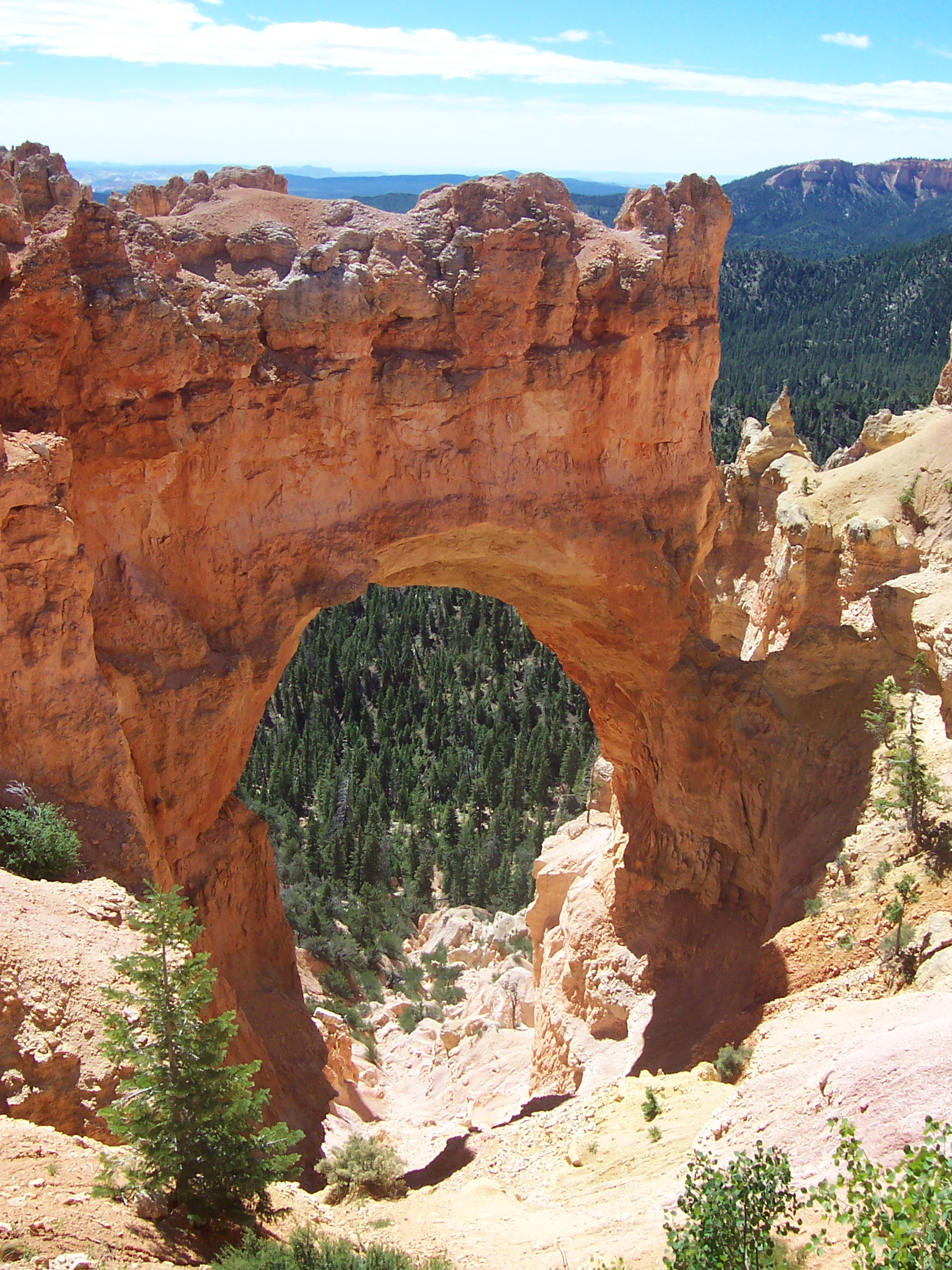
This picture below is called “Natural Bridge” even though it is really an arch —

Natural Bridge


I kept thinking of one of my main characters in Mark of the Pterren, a young girl named Arren, flying down the cliffside and swooping through this arch, laughing away with another character in a happy moment of exploration and friendship. The predominate image of her was age eleven though, older than she is in the first pterren book.

I had another character on my mind a lot, too, from my work in progress. Rowan Zroba, who is a mer-person.

Inspiration Point View 1


My mind was on ancient seas, and ancient lakes, and I often pictured all of these formations under saltwater. (And this land once was underwater, which makes imagining this even easier.)

Inspiration Point View 2


I tried to tell Greg about all the things on my mind, especially my book characters and how Rowan would swim and weave through these beautiful hoodoos —

on the hike


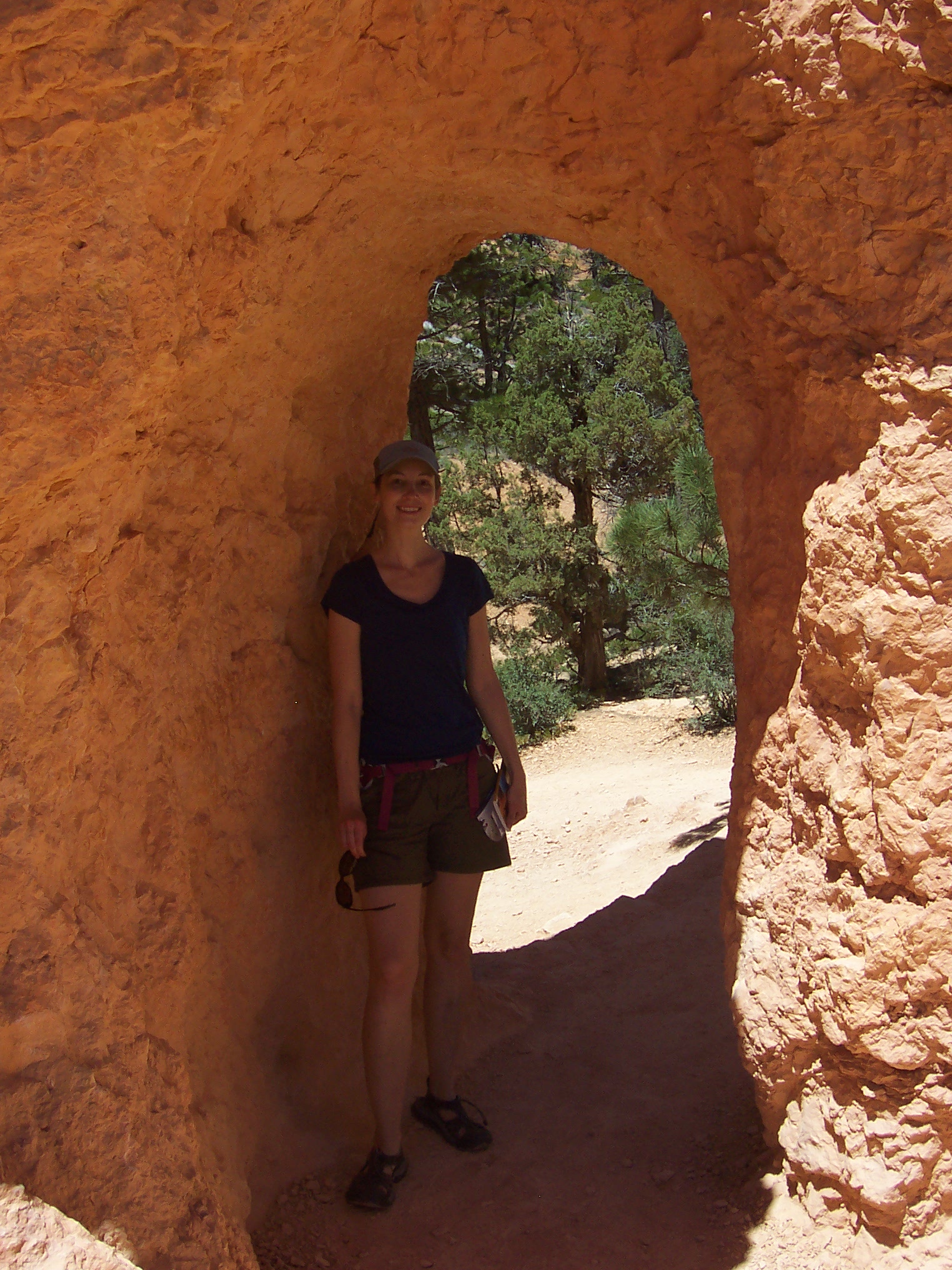
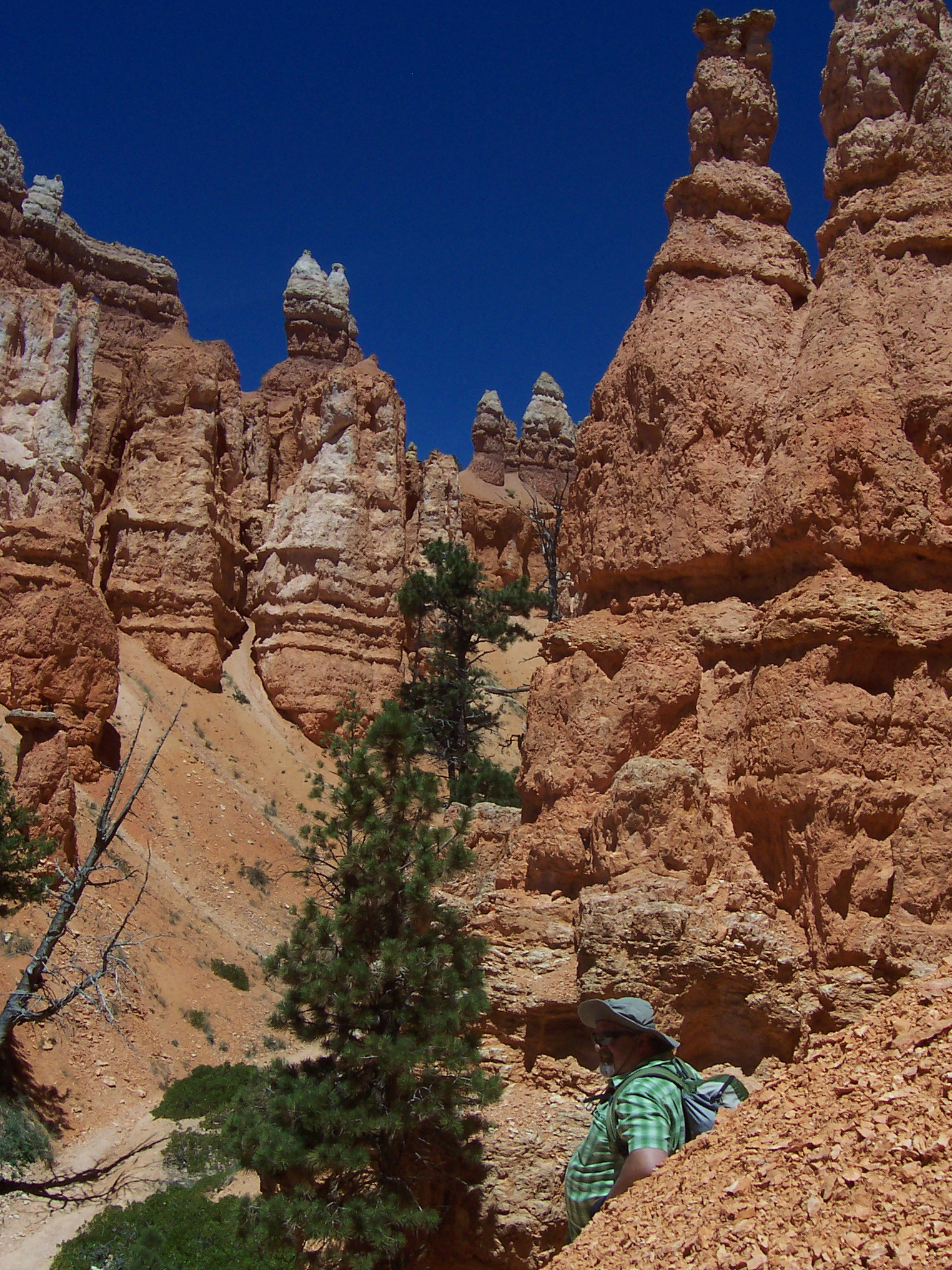
But Greg was in a really foul mood. Which he blamed on me. Because he brought my hiking boots, but I preferred to wear my Keen sandals to “hike” in (and I use the quote marks because our “hike” was really a “walk on a wide, clear path with some elevation change”). We hiked the Queen’s Garden trail, and part of the Navajo Loop, exiting the trail through a narrow canyon called “Wall Street” (which wore Greg out!).

me on hike


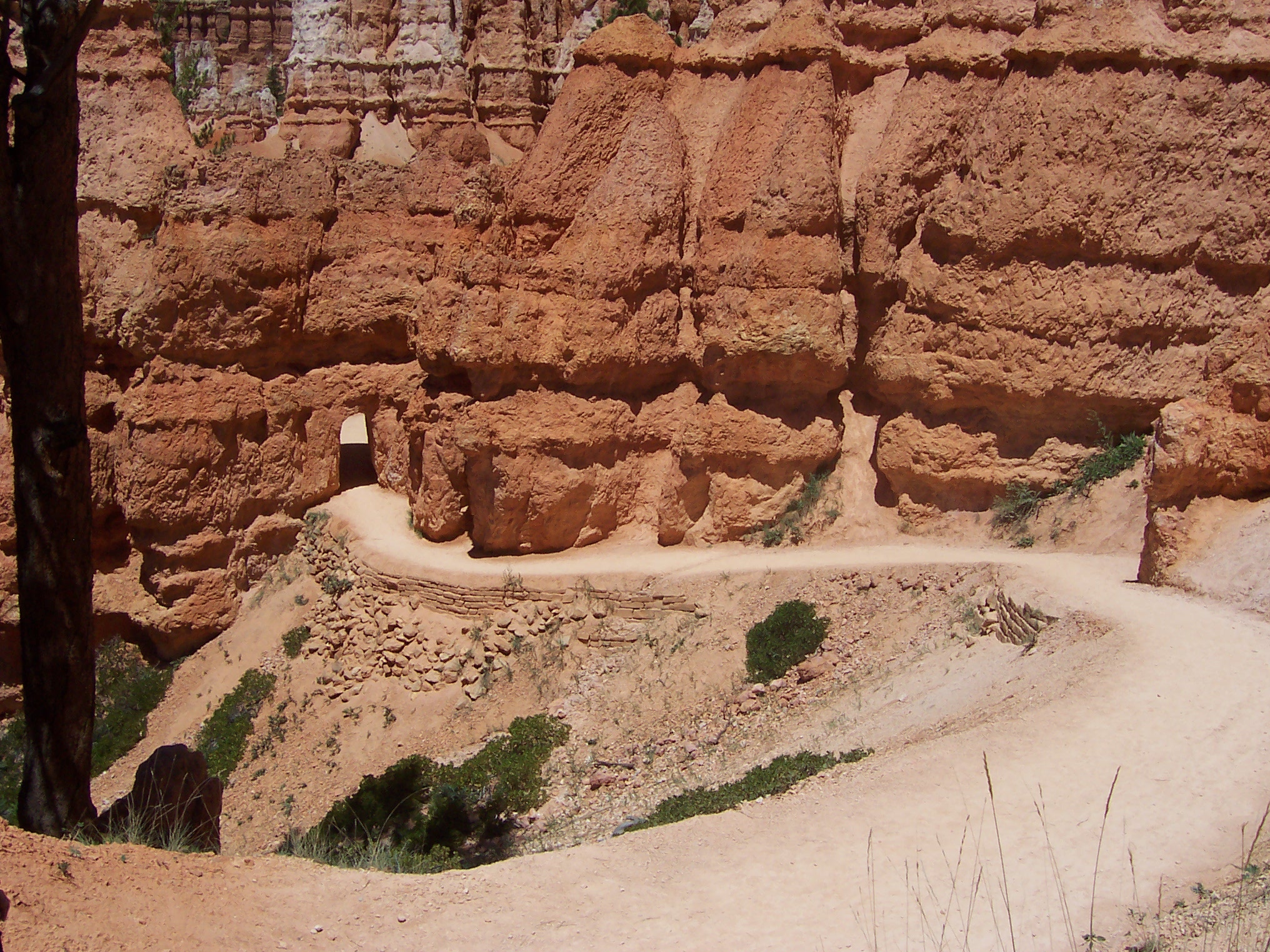
My willful “lack of care” with my health and safety had Greg all wound up, and he gets in a black mood in which it’s easy to forget that his anger is love, convoluted. There was no way for me to change his attitude, as I saw no reason to wear hot, heavy hiking boots for a non-strenuous walk through part of a canyon. Just look at how gradual and flat the Queen’s Garden trail is —

view of the Queen's Garden Trail


No way does that path necessitate hiking boots.

Greg on the trail


I also refused to “carry a coat” with me, just a long-sleeve shirt in my day pack, and Greg thought this was also an outrageous risk. The hiking trails are at a much lower elevation than Rainbow Point, and this was July 12, and the day was hot.

light rock


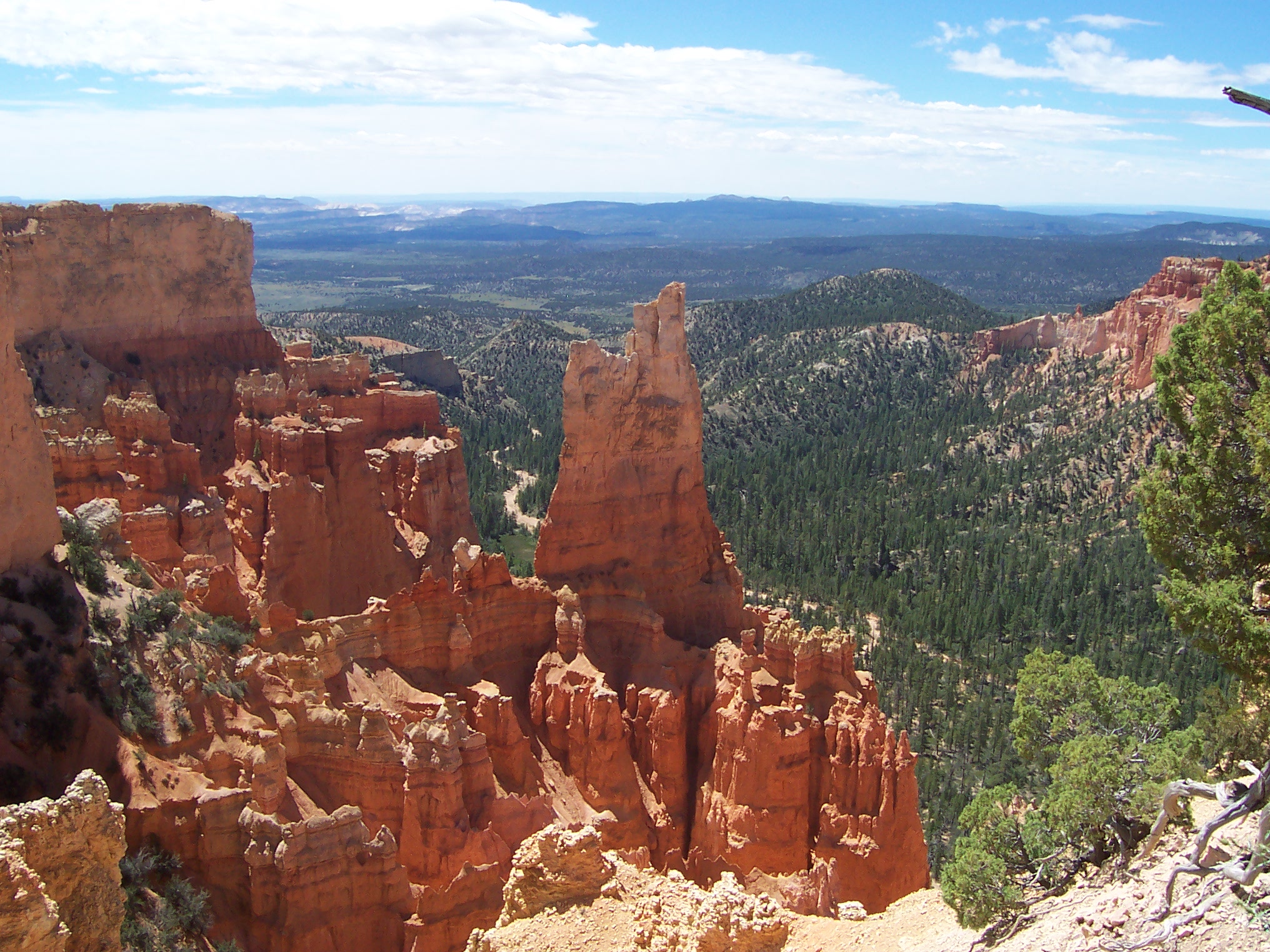
My favorite view of the day was the overlook of Paria Plateau (pictured below), I could just stare at this photo forever —

Peaceful Overlook_Paria View


I felt a great deal of peace standing there, and feel peace just gazing at this digital image.

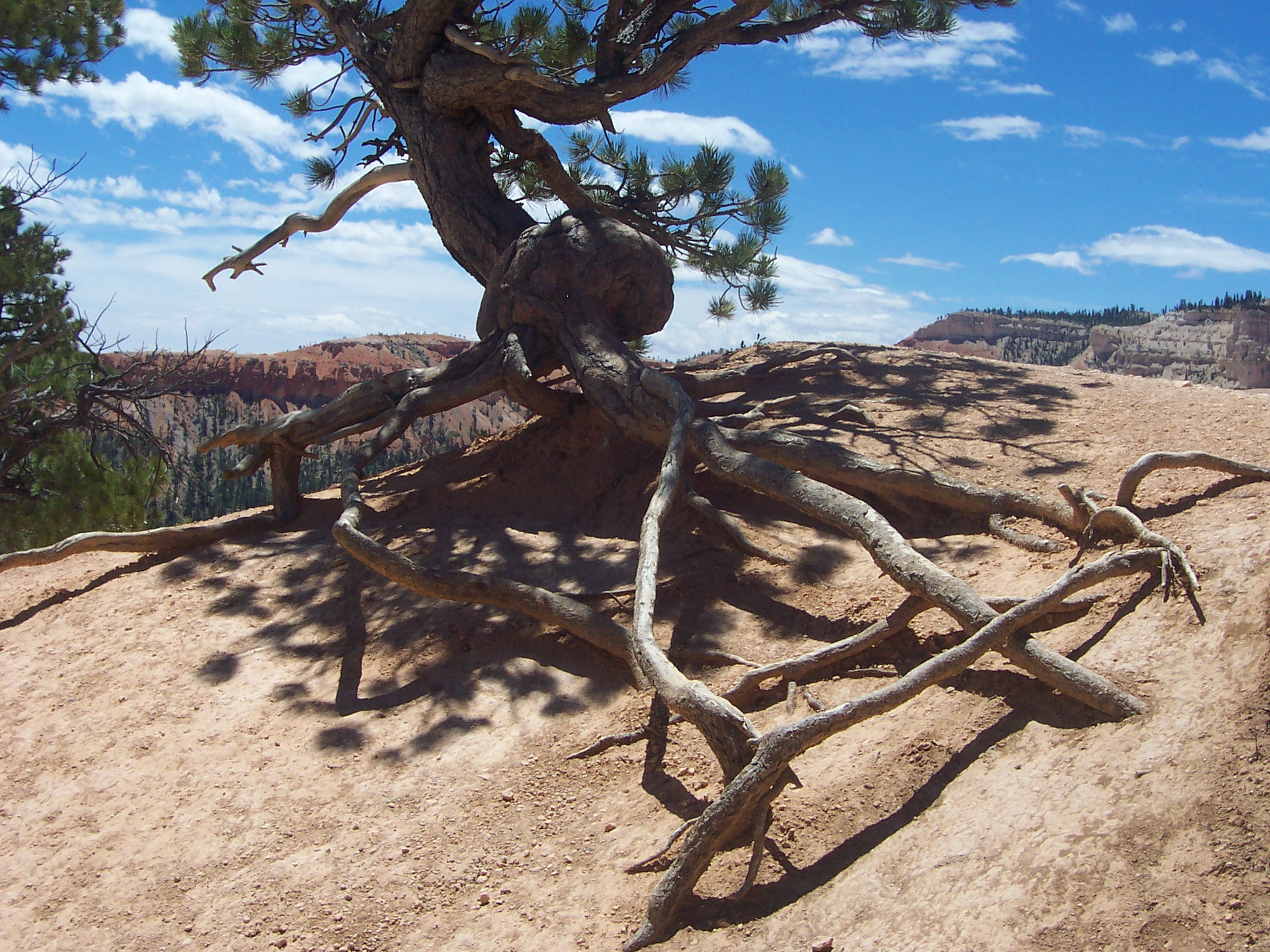
On the hike, this tree made me think of an octopus —

Cephalopod Tree


I don’t see a root ball, but a mantle and arms — and since Greg made it clear he didn’t want to hear about octopuses, mer-people, pterren, or plot ideas, and I didn’t have a computer to type on, my brain had a weird fizzle through the whole hike. My husband doesn’t realize the extent his bad moods can jam up the flow of a day, though I do realize his anger was not necessarily directed at me, but at things I can only guess at. Existential stuff, life, aging, mortality — the big, seemingly wordless terrors that can swoop down and grip us and render even the most cheerful optimist into a firey biped of frustration from time to time.

Or so I explained this mood to myself, anyway, since I am relegated to silence and DON’T TALK TO ME when Greg falls into one of his pits. I feel my neurons all misfire when that happens, when I want to share things and talk and make connections between patterns I see, but I’m not allowed to verbalize anything because my husband is MAD that I am wearing sandals.

But I wanted to see Bryce Canyon, and he took me there for that reason, and I love him, and sometimes marriage is loving someone who is in a foul mood because you’re wearing sandals.

another Paria view


Here is a picture of Greg with a raven, before we started our hike —

Greg with a raven


Ravens are so totally awesome. There’s a book called Mind of the Raven, by Bernd Heinrich, I really want to read. Books about animals rock my world.

I also saw this antelope with her twin fawns —

antelope with fawns


retreating


They were really adorable!

And after we finished our climb out of Wall Street (when the smooth gravel path switchbacked up a few hundred feet pretty quickly) Greg’s mood lightened and he stopped being a grump and became the sort of solicitous, “whatever you want, just ask” kind of person who was up for a picnic lunch and more driving around staring at hoodoos.

In our marriage, my books are the children, and oftentimes Greg gets upset if I give overmuch time and attention to the babies and he feels ignored. It took me many years before I figured this out. I try to watch out for this pitfall as much as I can, but there are times — like being told to wear my hiking boots — when I just disagree. Greg worries about me, and himself, and all the rest of everything there is to worry about in life. Mostly I just find myself pondering how harmful the concept of masculinity is, with its motto of “don’t be weak” and “anger is the only safe emotion to show” and “don’t be a pussy, just be mad and stay in control, real men are strong and in charge, and they keep women in line” and all the other internalized beliefs that are used to cover and mask vulnerability, when vulnerability is really not this horrible, evil thing that has to be hidden away.

Unless you’re a dude who wants to “be masculine” in an NFL-friendly, boxing-match sort of mindset, which is the predominant form of masculinity in American culture, especially for boys who grew up in the ’50s, ’60s, and ’70s — in which case, you’ve often got to choose between being a dick or being real, and old habits die hard.

gender-roles[1]


I didn’t start writing about men struggling with masculinity until I wrote Mark of the Pterren. That book has a lot of philosophy in it, even though I never use the word “masculinity” or anything remotely connected to terms like gender roles, unconscious belief systems, or existential crises. But it’s in there, embedded in how those characters talk, interact, and behave.

ax0X8abu[1]


I most love my husband when he is tender and nurturing, even though certain aspects of pop culture promote the idea that all women “want bad boys” or “hot guys with hot bods who treat women like sh*t” — which seems so bizarre to me. None of my female friends married men like that, so I’m not the only one who doesn’t fit this weird mindset of “treat me like garbage, as long as you’re hot, and hopefully rich, because money and looks are all that matter in a man.” Our culture projects this message onto children and adults in various ways, and I praise all the dads out there who allow their boys to express emotions other than anger. We need boys to grow up able to express vulnerable emotions, like sadness, fear, doubt, and pain. It’s the fathers of the world who have to open up a space for their sons to be vulnerable, and when I see men taking this risk — being real — this melts me.

blanket30fl-w800h800z1-38829-who-needs-gender-roles-when-we-can-have-pizza-rolls-blanket[1]


I know I’m not the only woman who feels this way. I like writing men who are vulnerable, and I like writing women who adhere to a “don’t be weak” mindset, because the richest stories often arise in that intersection between sex and character. In the places where culture and beliefs slam into biology, and the preprograming each of us has to be the person we are, the information wired into our brains, our neurons, our DNA. All of us have talents we are destined to search for and find, and that inward journey is either helped or inhibited in various ways, depending upon the time and place we’re born into. It’s fascinating!

My husband has a great big heart, and he has a very hard job in our marriage, being tied to a writer who talks about fantasy worlds as if they are real. I empathize.

After we left Bryce Canyon, we drove to Kodachrome State Park, in Utah, and the day was so hot that Greg stretched out under a picnic table at our campsite to nap. I was reading a biography of Margaret Mead at the time, but I put the book down when Greg curled up and said, “Greg! You look just like a big lion under there!” and proceeded to pet his head, shoulder, and back like I was stroking an African lion stretched out on the veldt. I wasn’t petting my husband, but a huge furry feline, and Greg lay there and let me be, and times like that, I know we are well suited for this trippy thing known as marriage.

2620060[1]


I’ll share my pictures from the rest of my trip soon — we had a marvelous six-day tour through southern Utah!

Posted in My Thoughts | 2 Comments

The Big Short, Michael Lewis, Brad Pitt and a New Movie

Like a lot of people, I’m a huge fan of Michael Lewis. Last summer, I read his newest book, Flash Boys, in a delirious, happy haze. That book made my Top Ten Best Books list of 2014.

Mar12_Lewis_230[1]


This year, on March 12, I had the privilege of meeting Michael Lewis in Aspen, Colorado. My Crazy Babe friend Adriana went with me, and she took pictures — so I have proof that yes, I met — and touched!! Michael Lewis.

Michael Lewis and me


When Adriana went outside to get her camera, I actually spoke to Michael Lewis — an exchange I had to keep very brief, because I almost burst into those super embarrassing, oh-my-god-I’m-meeting-my-hero tears. I blame my lack of control on getting old and being unable to deal with the overwhelm. When I met Michael Ondaatje, I couldn’t even talk. I shook his hand and ran away. When I met Laini Taylor, I had blubber-eyes. With Michael Lewis, I had to leave the table, pace around in the lobby a while, then Adriana came back inside and I was okay.

She also took a picture of the two of us with Michael Lewis’s son, Walker, who is totally adorable —

Michael Lewis, me and Walker


Aspen has an independent bookstore, Explore Booksellers, that has been in business for as many years as I’ve been going to Aspen. I’ve purchased many, many books from that shop, and on March 12, I bought a copy of The Big Short: Inside the Doomsday Machine. I’d been wanting to read this book for a long time, and that time finally arrived this summer.

6463967[1]


I love all of Michael Lewis’s books — and last week, I spent a fabulously long day reading The Big Short. I also watched several interviews Michael Lewis gave right after this book was published, which details events leading up to the financial collapse of 2008 — what caused it, and the people who saw the catastrophe coming and made a lot of money off the ridiculousness that was “the housing boom” (i.e. the subprime mortgage craze, i.e. sheer lunacy). I’ve read a lot of books about the collapse, but The Big Short provided insights I’ve never found elsewhere.

I highly, highly recommend this book to anyone who hasn’t read it yet.

The Big Short will be coming out as a movie in 2016. As I learned on March 12, Brad Pitt bought the film options right after the book came out in 2010. According to the cast list online, Brad Pitt plays Ben Hockett, Christian Bale plays the one-eyed genius Michael Burry, Ryan Gosling plays smart-gutsy-guy Greg Lippmann, and Steve Carell is playing the straight-talking Steve Eisman. All those actors are playing real people — really *awesome* people — and oh my goodness, I cannot wait to see this film!! It’s going to be so good!! So so good!!!

And just so you all know, Walker signed my copy of The Big Short along with his dad —

100_2279


Doesn’t Michael Lewis have such a swirly signature? I would never have guessed he’d make his initials so loopy.

There are few joys in life so great as seeing your name written by the hand of an author you love.

Whenever I see the words, To Melissa, followed by the signature of Michael Lewis, something inside me starts screaming in bliss. My inner fangirl is just beyond.

Posted in My Thoughts | Leave a comment

The Soul of an Octopus, Inside Out, and Other Fun Stuff

I’ve been doing a lot of ocean-related research this summer, as I write my Young Adult novel that is set in the sea, and I’ve discovered the work of Sy Montgomery.

SMontgomery33cw[1]


In 2011, she wrote a gorgeous essay titled “Deep Intellect” for Orion Magazine, about her brief encounters with an aquarium octopus named Athena. That beautiful essay went viral, and Sy Montgomery ended up expanding the piece into a book, The Soul of an Octopus, which debuted this May.

61FP-+bR3FL._SY344_BO1,204,203,200_[1]


I’ve been reading the book in small doses, since — much like the “Deep Intellect” essay — The Soul of an Octopus just turns on my waterworks and gets me blubbering. I have no problem accepting that animals have consciousness, a mind, creativity, and dreams. It’s depressing to me that there are so many folks in the world who believe only humans possess “intelligence” — I’ve never been one of those people. Reading about octopuses, animals that are so smart and beautiful, just gets my tears going. I’m easily overwhelmed by the magnificence of nature, and this is a magnificent book.

Equally amazing has been this nonfiction book —

kraken-cover-168x300[1]


Kraken: The Curious, Exciting and Slightly Disturbing Science of Squid, by Wendy Williams, published in 2011. This book is so freaking awesome, I don’t know how I lived my life up until now, missing out on this marvelous book. I’ve almost finished reading this one (I read each chapter twice), and have taken extensive notes. What I love most is that so much of my own sensibilities about how to think about life in the ocean is shared by Wendy Williams and Sy Montgomery. I feel like I’m hanging out with friends when I read their work.

Ditto for this book —

51pP75Lvz4L._SY344_BO1,204,203,200_[1]


Octopus: The Ocean’s Intelligent Invertebrate, by Jennifer Mather, Roland C. Anderson, and James B. Wood, published in 2010. This book is an absolute gem, full of scientific information as well as the sort of beautiful questions about intelligence and creativity shared by Wendy Williams and Sy Montgomery. These authors all know and interact with each other, and cite each other’s work in their books. It’s a wonderful experience to be reading all three at once.

On the movie front, I had a chance to see the Disney/Pixar movie Inside Out last weekend —

insideout-teaser-2-580x328[1]


A.O. Scott wrote a gorgeous review for this film in The New York Times — “Pixar’s ‘Inside Out’ Finds the Joy in Sadness, and Vice Versa” — so I expected to cry during this movie. But — surprisingly — I didn’t cry. What I felt was very wistful and happy that some children get to grow up with such sheltered, protected lives, like 11-year-old Riley does, the girl whose head we are in during the course of this movie. Riley lives with her mom and dad (lucky loo, right?), and suffers hardship when her family moves from Minnesota to San Francisco, while all their stuff is sent elsewhere. Here they are at their new place, eating Chinese takeout —

inside-out-rileys-parents[1]


The simplicity of this setup allows the story to focus — not on a bunch of external hardships, but the internal drama of emotion, conscious thought, the unconscious, and the personality traits that make up our character. Or, as A.O. Scott put it in his review, “The real action — the art, the comedy, the music and the poetry — unfolds among Riley’s personified feelings.”

Inside Out is a really great movie, what I would rank as a 4.5-star film (out of a possible 5-star review system). It’s super-creative (my favorite scene was when Joy and Sadness venture into abstract thought with Riley’s imaginary friend) — and I enjoyed seeing this movie on the big screen. I could have waited to see this one on DVD, but as far as animated pictures go, this one scores really high. I never felt bored, which was a huge problem for me when I saw Big Hero 6. My husband fell asleep during Big Hero 6, and he avoided watching Inside Out for that reason.

But the plot of Inside Out was far more inventive and fun, and I never felt anxious for the movie to just hurry up and end. The older I get, the more and more this matters to me, this issue of remaining engaged with art, of experiencing something novel. It’s the reason why I have no desire to see Jurassic World or Terminator: Genisys. Having read the reviews for those films, I know they will bore me, and why go be bored in a movie theater when I have books about octopuses to read?

Fans of Jurassic World point out, “But, Melissa — dinosaurs! You just go for the dinosaurs!” and “Who cares about the story — Arnie’s old self fights his current-old self in the new Terminator! It’s cool!” And I’m like, “Awesome, have fun. I’ll be reading.”

Pixar’s latest creation has plenty of novelty though, and I’ll close with one final thought on Inside Out.

Pixar Post - Inside Out characters closeup[1]


In the movie, the unconscious mind is portrayed as a dark, scary place where “Riley’s deepest fears” are locked up — when in reality, the newest brain and mind scientific studies keep insisting that our unconscious thoughts play a far more powerful role in “thinking” than we ever imagined before. The whole time I was watching the movie, I kept wishing that Joy, Sadness, Anger, Fear, and Disgust were operating the “control center” of Riley’s mind from inside the unconscious, as our emotions are powered by unconscious thought.

I also wish I could stop being so cerebral, and just watch the movie without pondering such things, and get to the end of the film feeling like, “now I’ll weep for all the lost childhood/child-selves whose simplistic ways of thinking are overtaken by the demands of growth, puberty, and adulthood” — but no. No tears and crying and bittersweet melancholy from me. I loved how the movie ended. I loved what happens with Riley’s imaginary friend.

But I didn’t weep — and I’m the girl who reads The Soul of an Octopus with tears streaming down my face — and I had a major overflow of unstoppable tears for Song of the Sea — but not for Inside Out. Lots of grownups are crying by the end of Inside Out. I feel like I am not the norm here at all.

As to other movies and pop-culture staples —

I’m hoping to see Spy in the theater tomorrow. I wanted to see it today, but Greg said he couldn’t deal with the crowds on the Fourth of July, so we have to wait a day. Tonight, we’ll be watching the last episode of Outlander on Starz, which I’ve been catching up on this week. We watched the episode “Wentworth Prison” last night, and it was totally horrifying. I’m never watching that episode ever again.

The Durango Public Library also relocated disc 2 of Game of Thrones: Season 4, which I have been waiting to borrow for three months, so I have another Game of Thrones episode to watch this weekend. I followed all the buzz about Sansa Stark’s rape in Season 5, which coincided with the Outlander episode “Wentworth Prison” when it aired on TV — and I have to admit, I dread watching Sansa’s rape, as “Wentworth Prison” was more than enough, horror-wise, for me.

In the meantime, there is a glorious thunderstorm taking place in Durango tonight, as Mother Nature celebrates a very delightful Fourth of July! Rain, rain, rain — I love it!!

Posted in My Thoughts | 2 Comments

Mad Max: Fury Road, and the Power of the Woman Warrior

Mad Max and I have a bit of a history. Not because I watched the original Mel Gibson films, but because I didn’t. Here’s why.

In 1990, when I was ten, I could rent a VHS tape of The Little Mermaid for 99 cents. I have no idea how many times I scoured acres of asphalt for stray pennies, so I could collect that magical 99 cents for a Friday night full of bliss. Suffice to say, I collected oodles of pennies during that year of my life, and rented this movie a lot. It was one of the most heroic accomplishments I could perform as a big sister, since my siblings loved this movie with equal passion. We were addicts.

One day, in a rare visit from my father, he saw me loading my coin purse with pennies, asked where I was going, and told me to bring home Star Wars instead. He let me keep my pennies, and gave me a dollar for the rental. Wrinkled and torn from his wallet. Pure gold. I raced off to the store fast as I could.

But when I arrived, Star Wars was already checked out. So was The Empire Strikes Back and Return of the Jedi. The clerk said, “Mad Max is in though. That’s the same kind of thing.” I was anxious, and thought I should just leave, but the clerk assured me my dad would be happy with Mad Max.

51X0P1YG2VL[1]


I was ten and clueless. Still young enough to believe adults. I gave the store clerk my father’s dollar, and took home Mad Max.

My father’s disappointment was profound. “This is NOT Star Wars! How could you DO this? What is the MATTER with you?”

I had wasted the dollar. He sent me back to the store. “You return that thing and you get my money back.”

So I rode back to the store and returned Mad Max. I was so horrified with my failure, I didn’t even take my coin purse with me for The Little Mermaid. The devastation was complete.

Even now, to think of the 1979 Mad Max, or the sequels, The Road Warrior and Beyond Thunderdome, takes me back to that day in childhood, when I failed my father and made him so angry with me. That day left a deep scar, and my father’s anger was enough to make me forever believe Mad Max was a whopping pile of sh*t in a world full of sh*t, and no one in her right mind would waste her time watching a crap picture.

But the new Mad Max: Fury Road didn’t have the same trauma attached. Yes, the term Mad Max is still a sore spot for me, but to my way of thinking, this was a new Mad Max. Reborn. Something that might be worthy of my money and time.

MadMaxFuryRoadPosterByDCDesigns[1]


Especially after I read the New York Times review by A.O. Scott — “Mad Max: Fury Road, Still Angry After All These Years.” It’s a great review, and earned the film the little NYT Critics’ Pick emblem that I always love spotting.

Which means it’s a movie that is not only well-executed, but will require you to use your brain on occasion. And I really like well-executed movies that allow me to think.

So on Sunday night, I went with Greg and Rachel to the theater, and we watched Mad Max: Fury Road.

There are elements to the movie I loved. The opening sequence is brilliant. Every second that opens this movie is an exquisite tribute to craft.

640_mad_max_fury_road_poste[1]


The one-armed Imperator Furiosa is as fabulous a film heroine badass ever created. Charlize Theron is such an amazing actor, and she brings every bit of ferocity into this role as you would expect.

furiosa[1]


I liked the weird suicide-promoting religion portrayed in the film. I liked how disgusting the bad guys are. I really liked the guy playing the guitar and all the war machine stuff. I liked that the audience is given just enough dialogue to make sense of what’s on screen.

Greg and Rachel weren’t fans — this film received a head shake from both of them. They pointed out that for the length of the movie, Furiosa and her crew are hauling around a tanker truck full of ‘mother’s milk’ (human milk) — a plot point which had gone over my head. I thought the truck was full of gasoline. But Greg and Rachel insisted only the small ‘fuel pod’ attached to the truck contained gasoline. The main tank was full of milk — which means these people were hauling around a bunch of dead weight for the entire movie, for no reason.

So yes, that is a big plot hole indeed. Because if that truck wasn’t full of gas, then Furiosa should have dropped the trailer, rather than waste precious fuel dragging pointless cargo. Plus, speed was an issue throughout the movie, and all that mother’s milk was just slowing the truck down.

1_Max[1]


So this movie was a bomb for Rachel and Greg. They were like, wtf through the whole film, because they noticed plot holes I didn’t. Like how the truck should’ve broken down, or at least run out of fuel, long before the end of the picture, and a number of other things I accepted as part of the magical realism that is an action movie.

Mad Max himself was decently cute. I liked his voice. Like many women, I have an automatic attraction to masculine voices, and the actor Tom Hardy has a nice one, a baritone that is very easy on the ears. He is nice to listen to. I wish he’d had more lines, so I could enjoy him more, but when he did speak, I was happy. His voice is one of the pleasures of the film.

I confess that I grew antsy before the end of the film. My brain doesn’t do well with action movies. I get bored. After an hour and a half of ACTION ACTION ACTION I just feel worn out. That was the case with Mad Max: Fury Road. The film is two hours long, so I was glad that, right after I reached my ‘okay, this movie can be over now’ limit, this woman showed up —

FURY ROAD


In the film, she is Valkyrie, a member of a band of older ass-kicking women called the Vuvalini. [Insert ‘vulva jokes’ here, since vulva is the term for the external genital organs for any female mammal, and was definitely the inspriation for the name Vuvalini.]

Despite the fact that the male gangs in this movie aren’t called the Dickalini, or the Erectarini, or the Penile-ini, this band of older women was my favorite part of the film. Valkyrie is played by a 39-year-old Australian model turned actor named Megan Gale. And she is smokin’ hot in this movie as one of the badass Vuvalini.

Here she is in full costume —

285B0AA300000578-3069449-image-m-2_1430870171822[1]


Man, I just love her threads in this pic. Except for the bare shoulders. No way would I ever kick it as a warrior with bare shoulders. But the rest of her look is coolness.

Overall, I’m glad I saw Mad Max: Fury Road. Seeing a band of ass-kicking older women in an action film is so much HELL TO THE YES that the movie was totally worth watching for them.

But if I’m going to recommend any film right now, it’s Ex Machina. I do much better with drama than action movies, and Ex Machina packs a fiercely awesome dramatic punch. Greg didn’t watch this one with me, but Rachel did, and she loved Ex Machinaloved it. So did I. I left the movie grinning, one of those yes Yes YES grins of I-just-watched-a-great-f*cking-movie pure awesomeness. Lots of fist-pumps for this dark and brilliant film.

file_124561_0_exmachinaposterlarge[1]

Posted in My Thoughts | 2 Comments