Sex, All the Sex, Sex Here, Sex Now, Yes to Sex!

I love the title of this blog post so much I’m considering making it the title of my next novel.

Except people might assume I was writing erotica, rather than science fiction, so that is a major drawback. False advertising and all.

Plus, there is not really all that much sex in Mark of the Pterren, which is unfortunate, as I’m sure I’d probably make actual money and quickly earn 200 Amazon reviews if I wrote like Jackie Collins or E.L. James or Nora Roberts.

But enough with my lack of marketing savvy. It’s time to prove this blog post is all about sex.

I give you —

This hot couple kissing

Hot_CoupleS_-_1024x768_-_Wallpapers_-_aman15-8.jpg_a_30[1]


And this guy grabbing this chick’s butt

acd20073af487119e8cb79ab5ffb6b5c[1]


And this guy with a really nice arm kissing this woman’s thigh —

HOT-COUPLE-8-Thigh-and-a-Kiss[1]


And these cute guys touching each other —

8e2adbbaf328754d8d7237a2e494adba[1]


And waterfall foreplay

Couples-Together-Love-hot-beach-Wet[1]


And these women kissing

imagesCAZ64SCU


And this guy with a five o’ clock shadow kissing a woman wearing a bra

images[4]


Can I deliver the goods, or what?

I promised All the Sex, and there it is! Throes of ecstasy and lips of passion and people with gym memberships and shiny long hair and black lacy underoos.

I also read an interesting nonfiction book this week, about the history of the sexual revolution, and feminism’s role within that revolution. The book was published in 1986, written by Barbara Ehrenreich (I adore Barbara Ehrenreich!!), and two other women named Elizabeth Hess and Gloria Jacobs, and it’s titled Re-Making Love: The Feminization of Sex.

I actually thought the book was going to be about how romance is portrayed in fiction, on film, and in other art mediums, but this book isn’t about the portrayal of love at all, but about the mechanics of women’s bodies, how those mechanics have been misunderstood (or outright lied about) over time, and how the sexual revolution that took place beginning in the ’50s with a gyrating Elvis, and continued throughout every decade since then, has led to a very different relationship between the sexes, including new understandings about homosexuality and transgender sex, by 1986. (The height of the AIDS scare, I might add.)

Though I was surprised to find myself reading about changing perceptions involving the blunt mechanics and purpose of sex, none of the information was really new. Especially since I read the nonfiction book What Do Women Want? Adventures in the Science of Female Desire over the summer, and blogged about how much I learned about sex from that book (which you can read here) — anyway, Re-Making Love didn’t contradict anything summarized in What Do Women Want? and was therefore even easier to read.

Re-Making Love illustrates the progression of where our common understanding of sex was in the Dark Ages (i.e. the 1950s and early ’60s), and quickly summarizes how America’s understanding of this body function transformed from an idea of sex as “missionary position between a man and woman to procreate” and the heinous belief that “women are not to feel pleasure, but endure this humiliation being done to their bodies for the sake of their husbands’ pleasure and to gain children” and the Freudian theory that “if women don’t orgasm from vaginal penetration alone, they are frigid” — which eventually gave way, over decades, to the modern understandings of “there is a variety of things people do with each other that can be called sex” and “women mainly have orgasms by stimulating the clitoris” and “sex does not need to exist solely for the purpose of procreation.”

I’m paraphrasing, but that is essentially what the book is about.

Chapter 3 is titled “The Lust Frontier: From Tupperware to Sadomasochism” and touches on those at-home marketing parties women throw for each other, which can involve tupperware, but can also involve sex toys and S/M supplies. I have never been to one of these sex-toy marketing parties, so it was nice that one such party was described in detail in the book.

Chapter 4 is titled “Fundamentalist Sex: Hitting Below the Bible Belt” and illustrates how modern Christian fundamentalism basically adheres to the tenets of sadomasochism, just without the safe words and any belief that women (the submissive partner, or “bottom”) should experience pleasure during sex.

(And remember, fundamentalism is different from evangelicalism, just so we’re clear — fundamentalists, in any religion, are a breed apart.)

fundamentalistcartoon[1]


(Fundamentalism involves extreme viewpoints, usually by making spiritual teachings political, which spurs vociferous activism, and the cartoon above illustrates why a lot of people are frightened of fundamentalism in any form, no matter which religion one is discussing.)

In Re-Making Love, there are several examples (given in quoted interviews) of fundamentalist women being brutally abused by their husbands (beatings, whippings, other violence, etc.), and when the abused women seek help, are told by their church officials that it is a woman’s job to submit to her husband, no matter what that husband is doing. However, while S/M sexual partners play roles during sex, they leave those roles when the experience is finished, whereas fundamentalist couples adopt S/M roles that never stop. The abuse is not created for mutual pleasure, and never ends.

Such a brutal existence, and not one I would ever want for myself. I love being cherished and taken care of by my husband, as well as having a division of labor in the home, and I like regarding my husband as my partner and teammate. It’s a mentality that has taken us more than 10 years of being together to reach, as we have fumbled along (as so many couples often do) in figuring out how to meet each other’s needs, but we have that teammate mentality now, and I would never give that up for a fundamentalist lifestyle.

Our spiritual beliefs, however, are ours to choose, and for some people, fundamentalism remains the best course of action. It can just make for challenging reading when the beliefs people choose institutionalize and condone abuse of any kind. A lot of us hold a counter belief that we should do no harm to others, first and foremost, and non-fundamentalist Christians often quote the “turn the other cheek” line from the Bible, rather than promote a “let your man beat you into the ground” mentality.

But there was actually one main idea I wanted to share in my post today, in reflecting on Re-Making Love, and that idea was motivated by a paragraph written in the book’s Conclusion.

In evaluating the sexual revolution as a whole, the book discusses women’s ambivalence about their hard-won sexual freedoms, by summarizing topics discussed in the book like the pill, legalized abortion, the continued stigma against promiscuity, the conservative backlash against urban single women, fear of AIDS and other STDs, the fear that giving men sex outside of marriage means men “will no longer marry” and leave women economically vulnerable– since many men still make a lot more money than women, etc.

Then there is this comment given in support of the statement that women are “more vulnerable than men to the hurts and dislocations of a society that is sexually more free than it is just or caring” (p.200) — (and this is the only place in the book where this topic was ever mentioned):

“And, sadly, women still ‘depreciate’ sexually far faster than men. The gray hairs and wrinkles that lend character to a man’s appearance only sabotage a woman’s. One result is that divorced men are much more likely to remarry than are their ex-wives, and the gap widens ominously with age.”

That’s all the book had to say on the matter of women and aging and appearance, as the paragraph ends there and the discussion goes back to women’s ambivalence about their hard-won sexual freedoms.

So I just want to say some things about women and their so-called “depreciation.”

You might want to strap on a helmet before you read my ideas about this.

imagesCAPOKI2D


Okay, helmet on? Here we go.

1. Not all people find aging people ugly, or “no longer sexually attractive.” Women included.

Are there men out there in their eighties (or nineties) flirting with teenage girls (and actively trying to have sex with them)? Sure. Are there men in their fifties marrying girls right out of high school? Sure. But not all men are like this. Personally, I don’t care much for people who put all of their sexual interest into a person’s outer packaging (which has nothing to do with us, it’s up to our genetics and so many other factors, 99.99% of which are completely beyond our control). I don’t find men (or women) who do this attractive, because I think obsessing to this degree over looks is stupid, and stupid, vain people are not sexually attractive to me.

Note: I don’t hate people like this, I just don’t want to spend my time around them. And I certainly wouldn’t want to go to bed with them. This type of thinking squicks me out.

2. Older men who are widowers have a much greater desire to remarry than older widows do. Men want to remarry in greater numbers. Women do not. For a lot of women, the freedom of staying single, or cohabitating, or just dating, is preferred. Men and women get different things out of marriage, and for a lot of women, one marriage is enough, and they simply don’t desire a second (or third, etc.). So why are women being viewed as “depreciating” because of lower remarriage numbers, when remarriage isn’t even something the majority of them want?

Seriously, this is just a ridiculous argument. If you are an aging widow, you are a f****ing badass, and I don’t think you should have to remarry for anyone to believe you still have worth. Be single, date, cohabitate, travel the world, swim with whales — it doesn’t matter to me, just go love yourself and rock it, and let someone else moan and cry about gray hair and wrinkles.

3. You are as attractive as you want to be. Charisma is internal. If you are a woman, and believe that your gray hair, wrinkles, and extra pounds make you unattractive, then that is what you will be: unattractive. If you are a woman who looks at older women right now and thinks, “Wow, that old woman is hideous,” then you are carrying a belief about older women “being ugly” that will damage your own aging sexuality more than any man will. We turn ourselves on or off (sexually) based upon the beliefs we carry about our bodies. If you think your aging body is ugly, then you will radiate that. If you think your aging body is beautiful, than you will radiate beauty. Simple.

4. We will always live in cultures that prioritize youth and a “cultural standard of beauty” to promote and sell art and merchandise. Youth is exciting because young people represent the unknown, and potential, and confusion about life. (Just look at the pictures I posted above for proof of this.) But as aging people know, there is still plenty of the unknown, and potential, and confusion about life as the years roll by and the wrinkles accumulate. That confusion just takes different shapes than high school or college woes, or starting-a-family woes, or buying-my-first-house woes, etc. Just because we slap young bodies on everything from car commercials to toothpaste doesn’t mean that there aren’t plenty of people who don’t fit that model, and still find each other beautiful. Please, do not buy into this belief that we all “turn ugly” (sexually or otherwise) as we age. As the decades roll by, people will still find you beautiful, and you can still find yourself beautiful, and seeing the beauty in yourself is far more important than other people seeing it, anyway.

And there you have it — my reflections on Re-Making Love, sex, and sexiness. You may unstrap your helmet and engage in some waterfall foreplay now. Or squeeze someone’s behind or something. Because I’m not ambivalent about the sexual revolution at all — I think it’s fantastic!! Yes to Sex! I’d put that on a bumper sticker, but people would probably mistake me for a hooker, which would be awkward, so I’ll just leave it here in my blog post, and go make some coffee. And return Re-Making Love to the library.

Posted in My Thoughts | 1 Comment

That Time I Had Hypothermia

On Friday, September 12, I had the privilege of spending my evening listening to Kevin Fedarko discuss his 2013 nonfiction book, The Emerald Mile: The Epic Story of the Fastest Ride in History Through the Heart of the Grand Canyon.

the-emerald-mile_original[1]


The book is out in paperback now. It’s been on by To Be Read list for a year.

The book trailer is really amazing! You can watch it here:
http://pshared.5min.com/Scripts/PlayerSeed.js?sid=281&width=560&height=345&playList=517784427


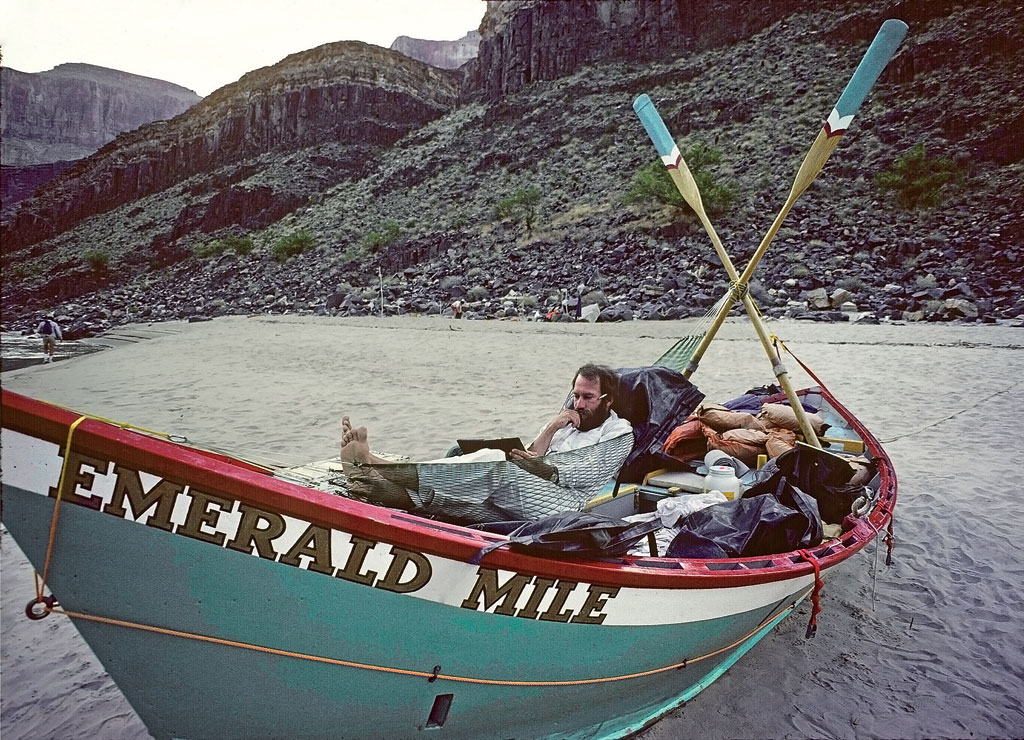
The story takes place in 1983, and follows three men in a small hand-built wooden boat called a dory, a dory named the Emerald Mile, which they take down the Colorado River during an epically-high amount of water in the Grand Canyon that year.

I attended the book signing and presentation with a bunch of people who showed up for free beer, which I didn’t drink because me and alcohol = no. Especially not beer, which I think smells like pee and the thought of drinking pee grosses me out.

A lot of the people around me were river rats, or people who are obsessed about running rivers in one form or another, whether in dories, kayaks, rafts, inner tubes, or any number of craft designed for floating down rapids.

Here is a picture of the famous Emerald Mile:

Grua in the Emerald Mile


And here is a picture of the book’s author, Kevin Fedarko, who is a really amazing guy, and a beautiful writer:

Kevin-Fedarko-Credit-Kurt-Markus-featured[1]


Kevin Fedarko is a cutie pie and super smart, which made him great fun to listen to. He is also working with a group called American Rivers and another group called Save the Confluence, because there is this complete dillweed developer, whose name I don’t remember, so I will call him Dillweed Developer, and Dillweed Developer is doing terrible things in the Grand Canyon right now. He’s a Wall Street tycoon with lots of money, and he’s been bribing Native American tribal councils to give him permission to fly helicopters (thousands and thousands of helicopters) over reservation land along the Grand Canyon, and build ugly resort-type things in that pristine region as well.

This is one of Dillweed Developer’s creations:

l-skywalk-240x132[1]


It’s officially called the Grand Canyon Skywalk, but a lot of river rafters apparently call it “the toilet seat.”

220px-SkywalkFromOutsideLedge[1]


The toilet seat is not technically built out over the Grand Canyon, but over one of the tributaries that feeds into the Colorado River.

To take a stroll on the Skywalk, you have to remove your shoes and put on a pair of slippers, and photography (including selfies) is prohibited.

The whole thing seems so random and bizarre to me, like something Miss Piggy dreamed up in a nightmare to tell Kermit, but apparently 200,000 people are now visiting the Grand Canyon Skywalk each year. I have no desire to put on slippers and walk the toilet seat, but then, I also have no desire to raft down the Grand Canyon, either.

In fact, as I was thinking about this whole presentation later, I found myself reflecting upon the one and only time I have ever been river rafting, and how much I totally hated it and never, ever want to go rafting again.

To use a word like “hate” to describe a recreational activity is so unlike my normal thinking, I need to explain a few things about that experience.

First, it was not my idea to go rafting. Ten years ago, I worked for a summer youth program called Voyager, making the typical $10.00 an hour most unskilled service jobs pay, and after two years with the program, the director decided to have a mandatory “staff bonding day” which would be unpaid — but free to attend — and the director chose the “staff bonding activity” to be a morning spent river rafting together.

We would complete this uber-important staff bonding activity before our summer program began, since we worked 6:30 a.m. until 6:00 p.m. Monday through Friday, running programs outdoors with children of all ages, from June 1 through Labor Day.

Therefore, our staff bonding day would take place two weekends before Memorial Day, because that was when the director could get “a really good deal” on the rafting price. Why would the trip be so incredibly cheap? Because in mid-May, it is still freezing flipping cold in Colorado and not an ideal time to go rafting. In fact, on the morning of our staff-bonding activity, it was snowing. Completely overcast, windy, and snowing.

imagesCAITGYRX


One woman on our staff was from Armenia, and barely knew how to swim. She was terrified — utterly terrified — to go rafting, but the director assured her she would be wearing a life vest, would not fall out of the boat, and would therefore not drown.

He also made it more than clear that if we chose not to participate, we would lose our jobs, and $10.00 an hour was actually good money in Ridgway and Ouray. Dishwashers, for instance, only made $8.00 an hour. The Armenian woman was terrified, but she arrived at 7:00 a.m. on the Sunday morning of the trip, because that is what people do to keep their jobs.

The river water, of course, was freezing that day. (Hello, it was snowing outside, plus, there was still snow on the ground.) No one on staff owned a wetsuit, except for the director, and we were told we could rent a wetsuit, but they cost like, $40.00 to rent, and that equated to 4 hours of labor (hard labor) in order to “be more comfortable” (as the river guides put it) on a mandatory, unpaid staff bonding day.

The director showed up wearing his wetsuit, but no one on staff, including me, rented a wetsuit for the day. I was already sacrificing hours of my time for this crappy rafting experience, and I sure as hell wasn’t parting with forty precious dollars of my hard-earned money for a wetsuit.

WaterProofW30FullSuit-sm[1]


I’m not a terrible swimmer, I spent a lot of time swimming in rivers as a child, and I was assigned to sit next to the terrified Armenian, once it came time to load up on the water. She spent most of her time on the trip screaming. Some of her screams were from fear, but most of her screams were from the ABSOLUTE HORROR that is river rafting in freezing cold water without wearing a wetsuit.

My husband can’t even listen to me retell this story without blowing a gasket. He hates the fact that I and my fellow staffers wore blue jeans on this rafting trip, when “everyone knows cotton kills.” True, we should have been wearing wool or synthetic material, except none of us owned wool or synthetic pants. But the fact remains, if you know you’re going to be repeatedly doused with freezing cold mountain runoff while it is snowing outside, you should NOT be wearing BLUE JEANS.

We were all wearing blue jeans, nonetheless. There were enough staff members to fill two rafts, and there were six people in mine.

I didn’t scream on the trip. I shivered violently, my teeth chattered so hard I probably chipped bone in several places, and I stoically completed this painful, and completely boring event, which was travelling 10-20 miles down the Uncompahgre River with a screaming Armenian and four other freezing people, forcing myself to smile and act like I was having a great time on our staff-bonding excursion, while being soaked with ice water.

After we reached the take-out (the place where the raft leaves the water), we had to ride back to Ridgway (where we had met up that morning), and then I had to drive home to Ouray.

So I was in my soaked jeans and boots for a good hour or so, on top of the hours spent soaked and freezing outdoors in the river raft.

When I arrived home, I stripped off my wet clothes, discovered my feet and legs were the deathly, frightening white of moderate hypothermia, and I planted myself, covered in blankets, directly in front of the furnace.

Our furnace blew out on the floor, the air hot enough to burn bare skin, but I sat in front of that furnace, with my bare feet pressed against the metal vent, for the next eight hours, shivering and teeth chattering, barely able to think. I didn’t watch movies. I stared at the wall, waiting for the moment when my shivering would end.

Eight hours of shivering later, I pried myself away from the furnace and went to bed. Without being next to the furnace, my shivers were worse, so I didn’t sleep much that night. The cold and the teeth-chattering was too invasive.

Now, you could say I would have been a lot better off forking over the $40.00 for the wetsuit, and you would be correct, except that was a LOT of money to me at the time (and it still is, really) and hypothermia is not a permanent condition. Spending money, however, IS permanent, as the only way to get more money is to spend more hours working for it, and in those days, I had far more important things to spend my money on than avoiding hypothermia. Like Sex and the City DVDs. And Hayao Miyazaki films.

I still own those DVDs. And I’ve never been river rafting again. Not just because I associate river rafting with hypothermia, which is certainly part of the reason. But I honestly just found it boring. So boring. The paddling, the floating, the splashing, the forced “Oh, aren’t we having a grand time!” social interaction that is part of a group activity like that. There was nothing exciting about any of it. I’d rather be hiking with friends, warm and dry, with a tasty meal in my pack, and if I’m alone, carrying a book to read when I find a comfy rock to sit on.

Which all begs the question: what am I doing reading a book about river rafting, if I don’t even like river rafting?

Well, simple: this girl I like loves the book, has repeatedly told me it’s her favorite book of all time, and the writing is solid.

So I will read it.

And I will do my level best not to think about that time I had hypothermia while I’m turning pages.

Posted in My Thoughts | 1 Comment

The Sons of Rome and Vladimir Putin

I have an embarrassing confession to make.

It has to do with what’s going on in Ukraine right now. With the separatists in the east.

Every time I try to listen to the news on this issue, my brain just wants to shut off.

brain[1]


Sometimes I stare at the TV and don’t take in a word. Sometimes I have to force myself to listen to a NewsHour segment two or three times. Sometimes I have to threaten myself I will start TAKING NOTES like a STUDENT unless I pay attention and listen the first time.

It’s just been this huge battle though. With my brain and the not-listening thing. It’s been really bothering me.

Because I only do this when I don’t see a reason to care. It’s not that I don’t care about all of humanity, or care that this fighting is going on, or care what happens to Ukraine.

It’s just that I don’t care enough to absorb detail. To listen to the particulars. I hear these news segments, and it’s just a stream of “blah blah blah, more fighting today, Putin is a dick, blah blah blah, the new government in Ukraine is condemning Russia’s involvement, the United States is meeting with foreign leaders, blah blah blah…”

It makes the NewsHour agonizing sometimes.

I decided I needed to do something. I needed to figure out a way to make my brain care.

So I said, “Who do I personally know who is like Putin? Who do I personally know who’s like the new Ukranian government? Or these separatists?”

And guess what my brain served up–

My book people, of course.

The Sons of Rome.

This whole situation is so similar to what I wrote about in The Etiquette of Wolves. And once my brain could put faces of people I cared about on the issue, I suddenly found myself able to absorb detail like a news journalist reporting in country.

So if you’ve read my first novel, then I hope you enjoy my comparison here, and perhaps learn something more about what’s going on in Ukraine right now. And who knows? Maybe this will help someone else absorb detail during news segments on the separatist movement. Cause I think being able to care about the news by making it more fun and entertaining is always a plus.

And if you haven’t read my first novel — you should probably stop reading this post — unless you like spoilers. In which case, read on.

images[9]


Okay, so first I needed to remind myself who the characters in the Sons of Rome were. Because my brain cannot instantly recall data like that. It takes a while.

But, given enough time, and a copy of the book to flip through: success!

In the hierarchy of men who compose this corrupt organization, which is also known as the Pack, Dean Declan was the baddest of them all. He was the Pack’s Dux Ducis, which is a Latin word for commander.

Who is the Dux Ducis in the Ukranian situation right now? Well, that would be this dude–

Vladimir_Putin_-_2006[1]


Vladimir Putin.

Current President of Russia. He’s been in power since 1999 as head of state, serving continuous terms as either Prime Minister or President.

Putin is the Dean Declan of the Pack.

And what is the Pack? That would be Russia, of course.

russ-MMAP-sm[1]


Look at how teeny tiny Ukraine is compared to Russia! In my novel, the Pack is in charge of a system of tunnels that stretch beneath the grounds of a fictional college campus, as well as tunnels beneath the woods that connect to the campus. Think of Moscow as being “home base” for the Pack–or the Alpha Tau fraternity house in the story. Moscow is Putin’s home base in real life, and the frat house is the Pack’s home base in the story.

Now think of Ukraine as being Kim Korra’s farmhouse. In my story, the land in Kim’s backyard was important to the founding of the Pack. It was the land where the original Pack held ceremonies.

Why is this bit of history important? Because around 1,500 years ago, Ukraine was actually the original Russia. During Roman times, a group of people called the Slavs expanded into southern Russia, travelling up the Dnieper River and founding places like Kiev, and the region we now know as Ukraine became Russia’s first civilization. The Slavs who settled there were eventually brought under Byzantine influence by Greek Orthodox missionaries. Around 863, two Greek monks, Cyril and Methodius, adapted the Greek alphabet so they could translate the Bible into Slavic languages. This Cyrillic alphabet became the written script used in Russia and Ukraine to the present.

Now, both Russia and Ukraine might use a Cyrillic alphabet, but Russian and Ukrainian are two distinct languages. Today, the dominant language of Ukraine is Ukrainian (native to 65% of the population), and Russian is the native language of 33% of Ukraine’s people.

So 2/3 of the people in Ukraine are native speakers of Ukrainian, and 1/3 are native speakers of Russian. This is important to keep in mind, as language is playing a huge role in the current separatist movement today, just like the use of Latin by the Pack in my story had its own role to play.

Given the fact that Ukraine formed Russia’s first civilization, when it comes to understanding the region’s history in the 20th century, and the rise of the Soviet Union, it seems like a given that the Soviets would want to have control of Ukraine, right?

Pretty much a no brainer.

how-american-corporations-have-made-america-like-the-soviet-union-e1342484108455-637x360[1]


Everybody knows the Soviet Union fell apart from within, crumbled and dissolved like the shoddy philosophy that forms the backbone of Communism.

Oh, snap. Here I go with my degredation of communism. My apologies– I have to add an aside here–

Because there is nothing like saying “communism is a flawed theory” to provoke immediate anger, so let me just state why I believe communism is flawed–

In reading history, I have learned that Marx had access to data that refuted his ideas, and yet he ignored that information and still wrote what he wrote, and people still used his work for their own power grabs, and that’s why I believe communism never works on a national scale. It’s also why I do not believe communism is an intelligent system of national government. However, if consenting adults want to live on small communal farms, where they can come and go as they please, cool. Successful communal farms have to maintain an open-door policy to thrive. Because forcing people to live as communists never works. Because the theory of communism is flawed.

This is my opinion, and this is how I explain to myself the internal collapse of the Soviet Union.

But back to my analogy with the current situation in Ukraine. Back to Putin.

Vladimir_Putin_-_2006[1]


Putin still has a Soviet Union mindset. In fact, many of the men in charge in Russia right now still do. Ukraine was Soviet territory, and many of those men still see it that way.

Post-Soviet Russia is a world full of corruption. Just like the Pack. Putin even got his start in the KGB, and he wasn’t the only one. His little oligarchy of sycophants are all these “we will make our enemies disappear” types who seem to have no qualms about killing anyone who’s causing “a problem” for them. There have been numerous reports concerning the corruption and overall scummy behavior going on with these men. Poisonings, torture, murders, imprisonments, etc. Bribes, bribes, bribes grease the financial wheels of modern Russia. You name it, and it’s happening there.

So Putin is the Dux Ducis, and I’d like to point something else out here, too. Something really cool about the title Dux Ducis, and why this is such a cool language link.

Now, a lot of you probably already know that the word czar is the Russian word for Caesar (which is Latin).

“The czar,” claimed Ivan the Great, “is in nature like all men, but in authority he is like the highest God.”

Sounds like a perfect recipe for corruption, doesn’t it?

Let’s just give our leader the authority and might of a God, and see how that works out, m’kay? Cause this plan has always been so ideal throughout history, hasn’t it?

I just love that there is this Roman element tying historical Russia to modern Russia, and then linking my analogy with my novel to modern Ukraine.

Because in my analogy, the Pack’s worship of Latin is like Russia’s worship of Russian. We’re talking about tradition here, and control, and power. Language is power. Controlling language is power.

Ever since the collapse of the Soviet Union, Ukraine has been under Russia’s control.

This year, the Ukrainian people largely said “no more” to this system. They wanted something different. So they rid themselves of their Russian-controlled government, and tried to make something new. They have a new President now, and his name is Petro Poroshenko.

Petro_Poroshenko[1]


Petro Poroshenko is the Dean Caffrey of my novel, the man who must set himself apart from the Pack and create something different. In my story, Dean Caffrey taught a business class for Timberline and Alistair, and Dean Caffrey is also a member of a group called the Animas, an opposition group to the Pack.

In my real-world analogy, the Animus is the European Union, the organization many Ukrainians want to join. It’s the whole reason Ukraine’s Russia-dominated government fell, the whole reason why Petro Poroshenko is now in charge.

Poroshenko’s home base is Kiev, the capital of Ukraine, and you can think of Kiev as Kim’s farmhouse, and the land of Ukraine as her backyard. Kim has a fairly large yard in the book, and there is a small area right next to the trees that she calls her meadow. At the end of the book, this is where the men wrestle, to decide once and for all who should be in control–Dean Declan or Dean Caffrey.

Vladimir Putin or Petro Poroshenko.

What land is the meadow in real life?

Eastern Ukraine. Where the Russian separatists are.

Ukraine-Map[1]


Who are these Russian separatists? They are members of the Pack, aka Russian forces, being sent into the meadow to battle it out for control of the land. To bring the land, and this upstart breakaway group of the Animas (Poroshenko and the EU-loving Ukrainians) back into line.

The Pack speaks Latin, the Russian forces speak Russian, and Poroshenko and his side speak Ukrainian.

Does Putin want all of Ukraine back under Russia’s control?

The answer is yes, of course he does. The fighting in eastern Ukraine is great for him. If he can seize territory for Russia, awesome for him. He’s hoping that Poroshenko’s government in Kiev will collapse, and that Ukraine will become a failed state.

Because we all know what the heck happens to a failed state. A power vacuum is a perfect situation for a foreign takeover. Just look at what’s going on in Iraq and Syria right now.

It comes down to a question of force. Who is stronger? The Animus or the Pack?

Taken like that, the Pack is definitely stronger. Russia is definitely stronger than Ukraine.

But there is one more player in the story, and in real life, and that player is NATO. In 1949, the United States, Canada, and nine Western European countries formed a new military alliance called the North Atlantic Treaty Organization. Members pledged to help one another if any one of them was attacked.

NATO-logo[1]


In my story, NATO is an alliance made by these individuals: Kim, Cadence, Timberline, Alistair, Jimmy, Noelle, Zach, Max, Evan– the friends banding together to survive against the Pack.

In the story, Dean Caffrey and the Animus join forces with the Jimmy/Cadence alliance.

In real life, Ukraine wants to join forces with NATO. Ukraine wants to be admitted as a member of NATO.

And Russia is like, “Oh hell to the NO you ARE NOT JOINING NATO. You are MINE and I will KILL YOU to KEEP YOU MINE.”

So here are Moscow’s current demands for Ukraine:

1. Ukraine must remain nonaligned with the EU and NATO. (In other words, Ukraine will remain under Russian influence. Or ELSE.)

2. The Russian language will have official status in Ukraine. (Which seems a bizarre demand, as Russian already has official status as a major language spoken in the country, but whatevs. Dean Declan would have been making demands like this, too, if this was happening in my story.)

3. There will be “sweeping autonomy” for the eastern provinces of Ukraine. (In other words, Russia will basically have control over that region, and Kiev can shove off.)

Control is a drug, a very powerful drug. And, like the high from a drug, it is a delusional power.

Do I think all the people of Russia are bad? Of course not. Do I think all people of Russia are corrupt? No.

Do I think Putin is evil? No. Do I think Putin is delusional? Yes. Does being delusional make him evil? No.

The world is what it is, and people struggle to find their own ways. Ukraine is doing that right now, and so is Russia. I just needed to be able to “give a face” to a large, nuanced, and multifaceted issue consuming large amounts of time on the PBS NewsHour, so I could listen more carefully.

This is simply what my brain delivered to help me listen better.

I’m an American, and I’m obviously biased toward America, and toward NATO and the EU. You can see all of my biases quite clearly in this analogy.

When I hear “NATO” in a segment on Ukraine now, and I think “Cadence and Jimmy and Timberline” it’s just easier for my brain to say, “Oh, what are they up to? I need to hear this!”

So I thank you for reading my mental gymnastics. Do you think I missed anything? Do you see a better comparison? I’d love to know!

Posted in My Thoughts | Leave a comment

Student Loans & Crying on National Television

Oh, student loans.

Oh, debt.

In all its forms, debt is challenging.

Predatory-Lending-Loan-Usury[1]


An easy trap to fall into. We want something so badly, and once we have it, the pain of paying for it takes its toll.

The PBS NewsHour featured segments all week (Aug. 25-29) on “Rethinking College” — bringing attention to a collection of issues facing public and private post-secondary institutions right now, including the growing problem of student loan debt.

One group highlighted by the NewsHour was One Wisconsin Now, an advocacy group in Wisconsin trying to organize student loan debtors into a voting bloc. The segment featuring One Wisconsin Now is 7:28 minutes long, and you can watch the piece here.

A recent college graduate named Ann DeGarmo was interviewed in conjunction with this segment, to provide an example of the skyrocketing costs of college and the increasing debt burden faced by graduates. If you watch the video, you will see that Ms. DeGarmo spends most of her time on camera crying and helpless, as she faces the full magnitude of owing $58,000.00 for the college degree she earned in May.

crying_baby[1]


It was difficult to watch Ms. DeGarmo shedding tears over her student loan debt on national television. I wanted to walk into her dorm room, sit beside her on the bed, and say, “Listen. You’re not helpless. You will get through this. You will be okay. You’re letting yourself panic over a future that has not come to pass. Assess your monthly student loan bill, and then make lifestyle choices accordingly. You’re a smart college grad, and I know you can make this work.”

Rational, head-on logic. No more tears. Let’s just get it together here, m-kay?

But. Because I couldn’t magic myself into a live interview that took place who-knows-when, I spent a lot of time thinking about Ms. DeGarmo this week. I watched the segment two more times, and then read the comments viewers posted in reaction to her.

When I read through the comments on the NewsHour webpage, I noticed two things: 1.) Most people who watch the NewsHour are Baby Boomers, meaning folks born between the years 1946 and 1964 (and I would expect many are Silents as well, the demographic of folks born between 1925 and 1945), and 2.) These Boomers and Silents have No Sympathy for Ms. DeGarmo — for her tears, her situation, or the debt she willingly signed up for to go to school.

evil_bankers_usury[1]


The words “willingly signed up for” being key to understanding their scorn.

Our hatred of moneylenders is constant and timeless, and it’s not a hatred I subscribe to unless the moneylenders in question are loaning money at compound interest rates above 25.99 percent.

Because then we’re in a different category of lenders. And, more importantly, a different category of borrowers. We’re either dealing with borrowers who understand what an interest rate above 25.99% means, and have no other choice but to borrow money at that kind of rate — (I’m thinking of entrepreneurs on Wall Street here, high-risk investors gambling with large sums of equity — or folks who have wrecked their credit, and still have to finance a vehicle or something, regardless of how jacked-up high their APR is). Those are the people who at least understand what a 25.99% interest rate means. (And it simply means this: You. Are. Screwed. Pay back that loan as fast as you can or you will be sorry. For reals.)

The other group of people in this category of borrowers are flat-out clueless folks who visit places like PayDay Loans, which can charge compound interest rates of 200.99% AND UP, and these borrowers simply don’t understand that this kind of lending should be illegal. (Maybe someone will comment and tell me it IS illegal now? I hope?)

But in case it is not–

When I hear the term “predatory lending,” it is this second category of lenders I’m thinking of. These lenders loan to people who are largely high school dropouts, illegal immigrants, people living in areas with no local banks, and working-class families who have fallen on hard times — taking out loans for as little as $25.00, and then spending years paying the loan back. Maybe they were unable to find another job, or couldn’t physically work anymore, or the breadwinner of the family died. These are also often people who don’t understand how to calculate interest, and might not even understand what the word “interest” means. For any number of reasons.

But Ms. DeGarmo isn’t taking out student loans with interest rates of 200.99%. As she made clear in the interview, half of her loans were from the federal government, and the other half were private — from banks and other lending institutions. And they’re probably charging her less than 10.99% interest on any of her loans (hopefully less than 3.99%).

53fbb7495ac42.preview-300[1]


So she meets all the categories of responsible borrowing. She doesn’t qualify for my label of “the evils of usury.”

Her tears were hard to watch. Not because I wanted someone to wave a magic wand and make her debt disappear. But because I wanted her to own up to paying back the money she’d borrowed. To get smart. To understand she can make budget and lifestyle choices to take responsibility for spending this money.

I wondered though. If I am some kind of rigid a**hole for thinking this way.

I mean, here is this young college graduate crying on national television, and instead of wanting to demand someone eliminate her debt, the same way people who run into massive credit card debt can file for bankruptcy and have their debt written down by the court — I just want Ms. DeGarmo to woman up and get smart.

Because — the hard reality — you can’t eliminate student loan debt in bankruptcy. If you sign up for that money, you’re paying it back till you die.

That’s what troubles me so deeply about this entire debate. People with credit card debt can default on repayment and have thousands of dollars cancelled off of their principal balance (and accumulated interest) for filing the correct papers in court. But student loan debtors can’t do that. The question of whether that law should be changed makes me want to pull my hair and just fret sometimes. Because I really don’t know.

Though I DO assume that, within the next 15 years, that law will probably change, and student loans will be treated like credit card debt.

Because we’re just in a state of insanity right now. One in four college grads is currently leaving school with more than $40,000.00 in loans for a 4-year degree. With so many people taking out loans to pay for degrees, I definitely foresee a change in how student loans are classified in bankruptcy court.

research-trilliondollardebt[1]


My personal value system just has a hard time with all debt cancellation, with writing off credit card debt as well as student loan debt. If you are an intelligent adult, and you sign a legal document willingly borrowing money for a reasonable interest rate — then I think you should do everything you can to honor your word, and repay the money, or simply don’t borrow so much to begin with. For college students, if that means going to a cheaper school, then so be it.

I wonder how I compare to my demographic cohorts in this? Because I’m not a Boomer or a Silent, but a Gen Xer, and Gen Xers are the people born between 1965 and 1980. Many of my close friends fall into that demographic. All of my siblings, however, are millennials, born after 1981. The largest burden of the growing student loan debt problem has fallen on millennials. Ms. DeGarmo is one such example, as she is (I’m assuming) 22 this year, recently finished with a 4-year degree, and would have therefore been born in 1992.

bigstock-education-and-internet-concept-47578906[1]


The whole point of the organization One Wisconsin Now is to organize the 40 million student loan debtors into a voting bloc, a bloc powerful enough to change the laws concerning student loan debt, and perhaps force the federal government to forgive the money these people owe.

In comparison, there are 65 million people on Social Security right now. And no politician messes with Social Security — or they kiss their glad-handing days goodbye.

So it sounds like One Wisconsin Now has some great numbers to achieve their aims.

Here’s my sneaking suspicion though.

Younger people don’t vote in the same numbers that older folks do.

And the people most at risk for defaulting on student loan debt — students of lower-income families, and students with massive debts from attending (what I think of as evil) for-profit universities —

I think those people vote in even lower numbers than millennials as a whole.

Which means I don’t see “student loan debt forgiveness” passing anytime soon.

Besides, the people most suffering this debt burden didn’t borrow from the federal government to begin with — they have private loans — and that would mean changing the laws for bankruptcy court for them to escape their debt burden.

Entire books have been written as to why tuition rates have skyrocketed since 1990. We know it’s not due to paying professors, but largely to fund new buildings on campus, especially flashy new dorms and student centers, fitness centers, sports centers, and sports programs. Schools do this in order to attract more students, of course.

Prepare-for-Skyrocketing-College-Costs-With-These-Tips-for-Investing-in-a-529-Plan[1]


I understand the impulse to do this, as the dorms I lived in at my university left a lot to be desired. My room even flooded my freshman year, and destroyed all my belongings, including my computer, which took me months of dealing with red tape to replace. I wouldn’t wish that kind of college experience on anyone. Shitty buildings make life shitty, and I’m all for having a decent standard of living while you’re going to school.

However. Students are paying for these upgrades. For the nicer standard of living on campus. And some of them will be paying for many years to come.

7-3-14tuitionskyrocketsjpg-015a79a4de76d526[1]


I still owe $6,300.00 on the $18,000.00 I originally borrowed to receive my bachelor’s degree. I’ve paid $104.11 per month on my debt since 2003 or 2004, when I had my loans refinanced and merged two bills into one. The money is withdrawn automatically from my checking account every month, and since a hundred dollars a month is fairly painless, you can tell how unmotivated I’ve been to pay off my student loan debt as quickly as possible.

I’ve done other things with my money. Paid for a beautiful wedding in 2006. Went back to India the summer of 2008. Saved up to leave my day job in 2011, and became a full time writer. I’ve given my money away to friends, so they can travel abroad, or have downpayments for vehicles, or visit Colorado to see me, or go on vacation with their children, or pay medical bills to stay in their homes. In 2012, I paid for medical bills and end-of-life care needs for my uncle. Then paid for probate costs in the handling of his estate, since the estate couldn’t afford those costs.

So that is just life. We make of it what we will.

I don’t regret my choices. I don’t regret that I still owe $6,300.00 for this amazing, wonderful thing I received for that money — my college diploma — and I’m certain I’ll pay all of the money back (hopefully sooner than later, but if it’s later, that’s okay). I’m living the life I want to live right now, and that’s what I wish I could tell Ms. DeGarmo. Student loan debt doesn’t stop your life.

t_63392dc554b2469c84c8b00023c6ba91[1]


Granted, if you owe more than $80,000.00 and have high interest rates (7% or more), your monthly paments can easily be more than $500.00 or even $800.00 a month. For those people, I support the iniative to cap student loan debt repayment at no more than 10% of a borrower’s income.

Because no one making $10.00 an hour (or less) with a college degree can afford to pay $800.00 a month for student loan debt. The reality for those graduates, or college dropouts with loans, is that many become homeless (living in vehicles or tents) or permanent couch-surfers.

But if they had a debt burden like mine, of a hundred dollars a month, I have a feeling the tears and the helplessness being expressed on national television would end.

Thanks for reading! I hope you’ll weigh in with your thoughts on this matter. Especially if you take the time to watch the video, and react to Ms. DeGarmo’s assessment of her potentially dismal future with student loan debt.

Posted in My Thoughts | Leave a comment

Flying Excrement in Durango

Many moons ago, circa April 2014, the City of Durango commenced a major road reconstruction project in town.

This highway reconstruction project is still underway, but the months of April, May, June, and July were the scene of the worst traffic jams I have ever witnessed here.

Durango is the place where highways 550 and 160 intersect, and that intersection is the busiest highway intersection on the whole western slope (the western half of Colorado). That’s according to data compiled by highway and traffic engineers.

The City of Durango, in one of their beautification planning sessions, decided this intersection needed to be more than just a bunch of concrete and asphalt. (It was obviously keeping people up at night, the idea that we had such an unartistic highway intersection in town. Something Had To Be Done. We are a town of awesome, and this drab crappiness of a traffic flow-through was not cutting the mustard.)

There’s a beautiful river walk through town that crosses under the bridge beside this intersection, but there was no pedestrian crosswalk on the highway. So plans were made to add a crosswalk on the west side of the bridge, and on the east side of the bridge, at the highway intersection, a sculpture would be added to beautify the former site of concrete nothingness.

Traffic engineers also decided the lanes of the highway needed to be rearranged into a new pattern, one resembling a preschooler’s attempt to draw the number 6 over a double set of railroad tracks — because this artistic highway design would help with traffic flow. (I can’t tell you how often I’ve thought to myself, “If only this really busy intersection resembled a small child’s picture of the number 6 over a double set of railroad tracks, the vehicular traffic would flow .003 seconds faster! Just think of the time we could all save on the road!”) Thank goodness a fleet of traffic engineers read my mind, drew up plans, and got moving on this, as it was about time this intersection met the space age.

Let the highway reconstruction project begin!

Months of traffic jams ensued. There were so many orange traffic cones and “lane closed” signs everywhere, my sister and I took to calling the turnoff to my house “the fires of Mordor” because all that glowing orange was truly reminiscent of Hell. Plus, sitting in traffic, not moving, for a half hour, just to drive 200 feet, and then spending another half hour to drive 200 feet more, is incredibly frustrating.

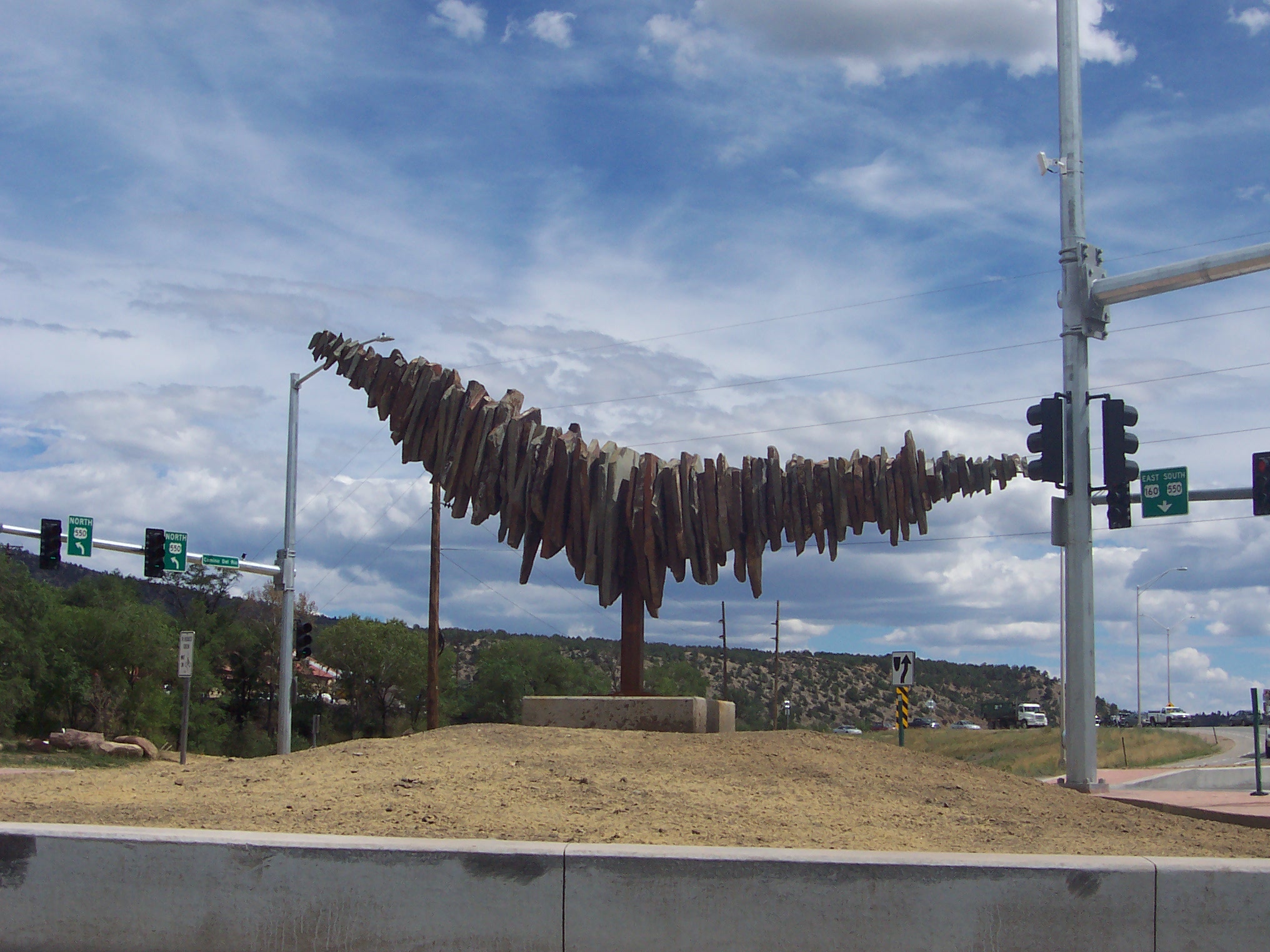
But after months of work, the big payoff arrived. The sea of construction cones and “lane closed” signs abated, traffic began to flow again (for the most part), and the intersection received a large statue of artwork– and the first time I saw it, near the end of July (when it was unveiled), Greg pointed through the windshield and said, “Turd rock.”

Because that’s what everyone at CDOT (the Colorado Dept. of Transportation) had already christened the statue: Turd Rock.

100_2037


I took this photograph of the city’s new artwork yesterday, while I was out walking. I live on highway 160, so I often walk into the center of town, cross the highway to the river walk trail, and then walk the river. So I pass by this area frequently.

I must admit, I was pretty shocked that THIS piece of artwork was what had caused all those long months of traffic jams. The whole experience of making a space for this artwork was seriously agonizing. I still cringe sometimes leaving my house, anticipating the total nightmare of driving Hell that was this road reconstruction project, because even though the craziness has calmed, the crosswalk isn’t finished yet, and lanes still periodically close.

But anyway. Back to Turd Rock.

What you are looking at is a vertical metal pole attached to a horizontal metal pole with a bunch of thin, squarish rocks strung along it, like beads on a string.

Here is how Neil and Marti Bourjaily described the artwork in a Letter to the Editor (The Durango Herald) on August 9, 2014:

// “The sculpture at the Highway 160/550 intersection is symbolic in the way all good art is symbolic.

Look at it in a new light to appreciate its value at this major intersection. Consider that each slab of stone represents an individual in Durango. See the unifying construction represented in the shaft that pierces each individual stone, seemingly going where all such shafts go. The sculpture does indeed represent the way Durangoans receive their highway funds and design.”

If you are wondering why someone is writing a Letter to the Editor blatantly saying local residents were “shafted” by this piece of artwork– well, let’s just say, people caught on pretty quickly to the epithet Turd Rock.

Here is what Catherine Crowel had to say in her Letter to the Editor (The Durango Herald) on August 10, 2014:

// “I would like to know what the city of Durango and the artist were thinking when they put the sculpture of what appears to be a flying piece of excrement at the intersection of Highways 160 and 550. If this is supposed to represent Durango, in my opinion, they all failed with this one.

Bikes, just like the ones at the roundabout at Chapman Hill, a train or even the mountains are a better representation of our area versus this thing. Sometimes, I wonder what people are thinking when they are coming up with ideas, and I’m sure people are having a great laugh at our expense because of this thing. Way to go, Durango!”

Davitt M. Armstrong suggested the scultpure could be thought of as Durango’s “Giant Stone Batman signal” (The Durango Herald, August 10, 2014): “I breathlessly await the arrival of the Giant Stone Batman to put our hapless community to rights. He’ll have plenty to keep himself occupied simply protecting inept drivers around the Hollywood crash-course designed by our fearless engineers.”

Mr. Armstrong is clearly not a fan of the new intersection design OR this piece of artwork that now looms above it.

Plenty of other people wrote in to complain, express horror, and make jokes about this statue. To say there was an uproar in town over this piece of art is putting it mildly.

After an avalanche of negativity about Turd Rock, which is actually named Arc of History, several people wrote in to defend the sculpture and the city. Some call the sculpture an important addition to the city’s collection of art, some compare the Arc of History to wings (representing freedom), or think it looks like a petrified dinosaur.

I just find the whole thing hilarious. The art, the uproar, the constant Letters to the Editor expressing frustration and outrage, and the way Arc of History was immediately named Turd Rock.

I’m also grateful the fires of Mordor have died down to embers, and that there is now a pedestrian crosswalk across highway 160, because I use it every day.

Posted in My Thoughts | Leave a comment

Iggy Azalea, Nicki Minaj, and Selling It in Hip Hop

I confess I’m not hip to a lot of pop culture– most especially hot new artists in the music world. So when the song “Fancy” started receiving major air time on my local radio station, I thought it was a Nicki Minaj and Gwen Stefani mash-up. Because the rap sections sounded like Nicki to me, and the refrain (“I’m so fancy!”) sounded like Gwen Stefani.

Speaking of Nicki Minaj, my local DJs have been adding to the media noise around her recently-released cover for Anaconda. The world of rap is totally abuzz with this picture–

nicki-minaj-anaconda_-cer-art-billboard-650[1]


Most people are either 1.) turned on, or 2.) angry that Nicki Minaj compares herself to Lauryn Hill, and then acts like a pole dancer.

Or something like that.

As far as I’m concerned, Nicki has a right to use her body however she wants to. If she decides to take a picture of herself in a pink thong to sell her music, so be it. The image is new, but the general theme of women utilizing their physical assets to sell their music is not.

But back to this “Fancy” song.

Which is not a Nicki Minaj-Gwen Stefani mash-up.

It’s actually being rapped by this woman–

iggy-azalea-650[1]


Iggy Azalea.

Real name: Amethyst Amelia Kelly. (Beautiful name, huh? I love it. Her stage name is badass as well.)

She was born June 7, 1990, which makes her a whopping 24 years old. Originally from Australia, Iggy Azalea started rapping at 14, dropped out of high school, and moved to the United States at the age of 16 (by herself) to pursue a career in hip hop music. She lived in Miami and other parts of the south, and gained recognition when her extremely explicit rap songs “Pu$$y” and “Two Times” went viral on YouTube.

She’s extremely driven. And, like Nicki, her derrière is uber-famous. Iggy Azalea works as a model now, as well as making use of her talents as a songwriter and rapper.

The refrain in “Fancy” is sung by this gal, Charli XCX–

charli-xcx_07-09-13_7_51dc3d2b9dcf2[1]


In the music video, these two women pay homage to the film Clueless. The music video is a high-production recreation of memorable moments from the movie–

Just be warned that this is rap, and the word “explicit” is there in the title description.

Also, this is the first time I’ve ever embedded a video link into my blog, which I am super excited about!!!!!

I feel like such a smartie now!!!

But back to Iggy Azalea. And the whole reason I wanted to blog about her today.

There are really funny parodies of “Fancy,” and more keep being made every day.

This one — “I’m So Married” — is my favorite–

I just get such a kick out of the visuals and lyrics to this one, mostly because I reflect on the inherent absurdities of modern middle-class life that this music video makes use of.

“I’m the B-O-double-S, put my name in bold, For every strong man, a stronger woman I’m told” — I mean, there are just some really hilarious, really great rap lines in this parody.

Granted, I didn’t eat frozen wedding cake a year after my ceremony, I didn’t announce my marriage on Facebook, I didn’t change my last name so “all the boys would know” — and my husband doesn’t leave up the toilet seat, nor does he read on the toilet, et cetera, et cetera — but I still feel myself laughing all over when I watch this video. By “laughing all over” I mean the bubbly sort of happiness that hits your system like fizz, so you forget you’re sitting in a chair looking at a computer screen, you’re just feeling fizzy instead.

Iggy Azalea watches these parodies, too, and her favorite one is “I’m So Pregnant”–

This music video is certainly funny, with a lot of truth in it (“Who dat, who dat, Pre-G-G-O”) but I just personally like “I’m So Married” the best.

These videos inspired me to learn how to embed links on my page, made me laugh, and I learned more about a new rapper in the hip hop scene.

Reflecting on rap today, I am so, so glad I don’t have to put on a thong and take near-nude photos of myself to sell my novels.

Plus, I don’t have to twerk.

*sigh of relief*

Cause I just wasn’t cut out for thong photos and twerking. Dressing up as Wonder Woman to promote literacy? Sure, I can manage that. Passing out postcards with my book covers on them? No prob.

Pretending I’m a pole dancer for an album cover? Twerking on stage? Rapping a song about comparing my lady parts (“taste the rainbow”) to Skittles — ? Um, yeah. Not for me.

But isn’t it fascinating that people do this stuff? To make money, or just to have fun? I find it so incredibly delightful that there is no end to art. To silliness. To goofball sex. Cause that’s what all three of these videos (and the Nicki Minaj cover) say to me– that sex is truly a very goofy thing. Especially when it’s in the hands of women using it for their own purposes. Cause women are running the show in all of these examples. And that’s pretty cool.

Posted in My Thoughts | Leave a comment

Edith Wharton and Ethan Frome

The day before my husband and I went to Yellowstone this summer, we stopped at a used bookshop in Missoula.

Missoula, Montana, is one of those places that is never far from my radar, as a lot of people I meet in southwest Colorado have lived in Missoula. Mountain people tend to have locations in common, and Missoula and Durango are similar beasts. In the same regard, Aspen, Telluride, Sun Valley, and Jackson Hole occupy a strata of mountain town separate from the Missoulas and Durangos of the world. The separation is created by class, and whenever I look at the world through that lens, I feel like a child with a stick poking at things that don’t want to be poked. Which leads me to the topic of my blog today: Edith Wharton.

But back to Missoula first. And the bookshop.

I’d never been to Missoula, and though Greg and I didn’t spend much time downtown, bookshops are always a must. There was a first edition of The God of Small Things on sale in this store for $7.00. I would have purchased this book, but the interior of the hardcover binding was torn. I gazed over the literary fiction shelves for about 15 minutes, and there was a guy shopping the same shelves who was rather annoying. He bumped into me twice walking by, even though there was plenty of room to navigate between the shelves without coming into physical contact.

I didn’t get the sense this guy was flirting at all, just that he was being a jerk. He seemed a good ten years younger than me, and ramming my shoulder was definitely his fault, but he never said he was sorry, or acknowledged what he had done in any way. Did he perhaps have a mental disorder of some kind? I didn’t ask, probably because I didn’t care for the look of his face, which I labeled as smug. Also, the smell of old books is different from the smell of new books, and sometimes that odor overpowers me in unpleasant ways. This shop was full of old, musty books, especially of the nonfiction variety (and we all know that nonfiction books just don’t age well at all– while most fiction is timeless, most nonfiction has a shelf life, and then curdles quickly)– anyway, that strong musty smell, and this uncouth male shopper, kept my browsing time limited to ten minutes.

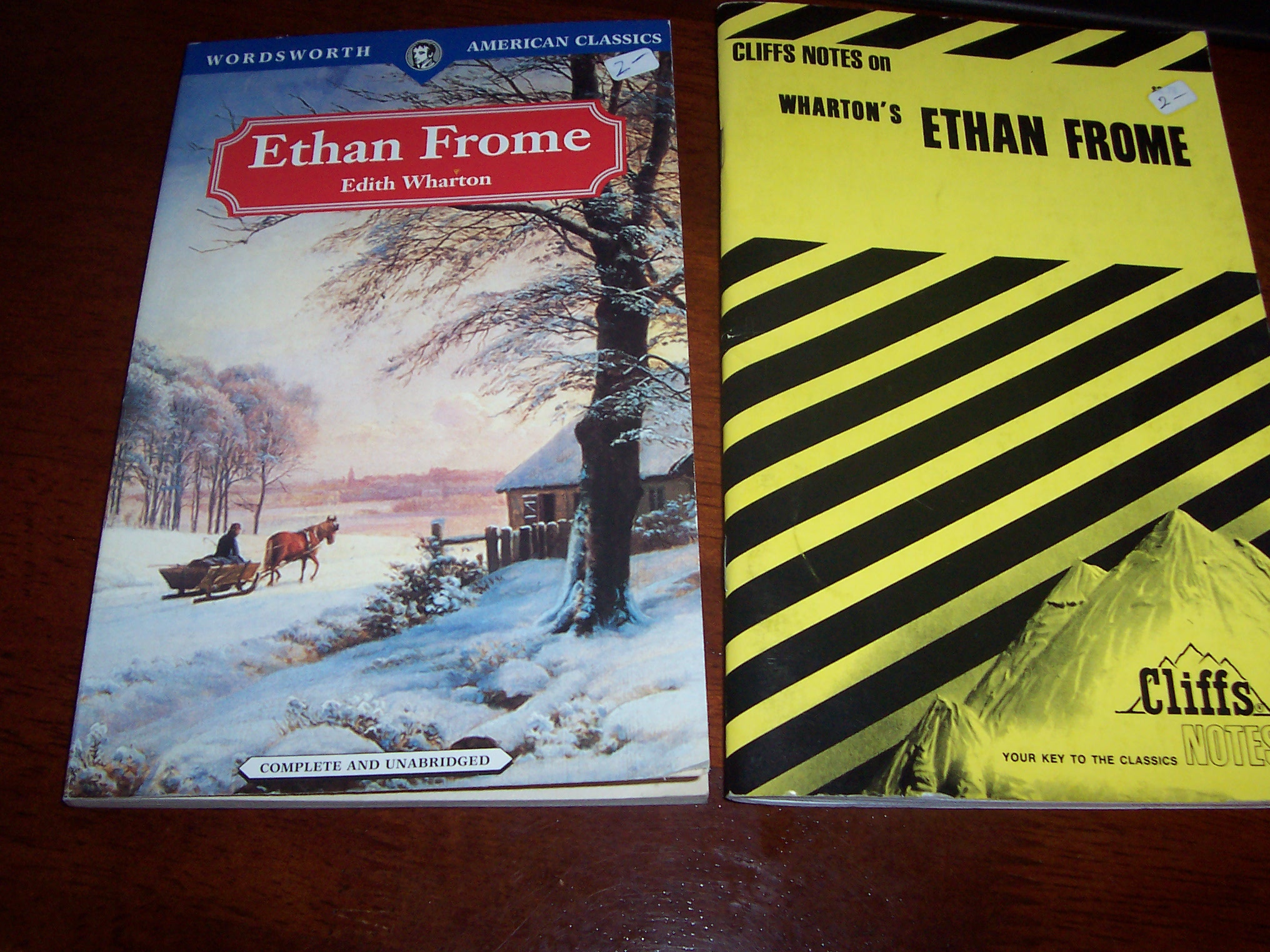
But what a productive ten minutes it was! I found a copy of Ethan Frome for only $2.00– and this copy had an introduction written by Dr. Donald R. Makosky, Professor of English, St. Lawrence University.

Since St. Lawrence University is my alma mater, I knew this book was mine. I also found a copy of the Cliffs Notes on Ethan Frome, which was also only $2.00.

My new treasure–

100_2011


I’ve only read one other Cliffs Notes, and that was for The Sound and the Fury, one of the most agonizing reads I’ve ever undertaken. Since I knew nothing about Edith Wharton, and had no way to google her in the car, I bought the Cliffs Notes so I could read about her. I was also a little scared I wouldn’t understand Ethan Frome, since I’d never read Edith Wharton before, and this book was published in 1911.

A few minutes later, back in the car on our way to Yellowstone, I read about Edith Wharton’s life, and then started reading Ethan Frome. I read aloud, so Greg could hear. And also because, when reading difficult text, speaking the words helps my brain’s comprehension.

Which, looking back, seems ridiculous. That I worried so much. Because Ethan Frome is nothing like reading Faulkner. Ethan Frome is easy to read, and so completely enjoyable that Greg was totally hooked. Greg does not enjoy fiction, doesn’t care for novels at all, but he couldn’t get enough of Ethan Frome, and he hung on every word. Even once we arrived home, and were no longer trapped in the car (providing an excuse for this reading exercise), I brought the book into bed and finished reading it to him there. My husband really enjoyed this novel, and so did I.

Edith Wharton was the first woman to win a Pulitzer Prize for a novel (The Age of Innocence, published in 1920, prize awarded to Wharton in 1921– also the year women received the right to vote in America, no small coincidence)– and just look at this picture of her as a young woman–

edith-wharton[1]


I know I shouldn’t worship at the altar of youth and beauty, but sometimes it’s just impossible not to. Sometimes I just have to stare at a picture and be allowed to say, “Ohhhhhh…” with the sort of wonderment I displayed for My Little Ponies circa 1986. Because the little kid in all of us never stops responding to being dazzled, and Edith Wharton is simply dazzling. As a person, in her life, in her work, in her passion, this woman was a powerhouse, and this photograph is an image of someone who was beautiful inside and out.

The Cliffs Notes provided far more information about Edith Wharton’s marriage and love life than most websites do, so my $2.00 purchase was far better than a smart phone would have been. The websites mention more of her amazing charity work during and after World War I, which is great, but knowing how much Edith Wharton struggled to find herself, embrace her gifts, and experience love, makes the fact of her charity work all the more meaningful and beautiful to read about. History has a terrible way of distorting people, of making them dry and colorless, rather than the complicated, passionate, sexual creatures we are during our time on earth. Edith Wharton was a total badass while she was alive, and I’m grateful I finally started reading her work.

Also, I should say it’s inspiring that she didn’t write her first book until she was 36, and didn’t publish her first book until she was 40, when she is obviously completely brilliant, and could have been publishing books long before then. Cliffs Notes focused on the beauty of her language, the genius of her word choice, but Edith Wharton is far more than a wordsmith of beautiful sentences. She is a master of plot, and that is what made Ethan Frome so addictive, and kept my husband and I enthralled– that short little book invites the reader to tear through it, desperate to find out what has happened to Ethan and the woman he loves– and the ending is startling and powerful, the product of a master storyteller. Like an MLB pitcher with a wicked good curveball. I didn’t see that ending coming at all.

What I always knew of Edith Wharton, before reading her work, was that she was a girl with a stick, poking at issues of class that didn’t want to be poked. She didn’t write magical realism, she wrote social realism, especially tales of the wealthy members of the Gilded Age watching their vanishing lifestyle. Like Proust, she is a writer who evokes nostalgia, an awareness of time passing, distorting our memories, distorting what we understand of ourselves.

After reading Ethan Frome, my earlier knowledge of Edith Wharton and her work is still true, but now I know she isn’t anything like reading Faulkner. She has an accessible voice in her work, and writes with plot, really good plot. She was a deeply fascinating person who loved to travel, loved to help the less fortunate, loved France, loved gardening and designing things, and was just overall awesome. So here was another discovery I made while on vacation: Edith Wharton is a complete badass.

I’m really looking forward to reading The House of Mirth (1905) and The Age of Innocence. I’d also like to read a biography of her as well.

I have officially entered the I’ve-read-Edith-Wharton club. It’s a great club to be a member of. Highly recommended.

Posted in My Thoughts | 1 Comment

Boy, Snow, Bird: Race, Fairy Tales, and a Missing Plot

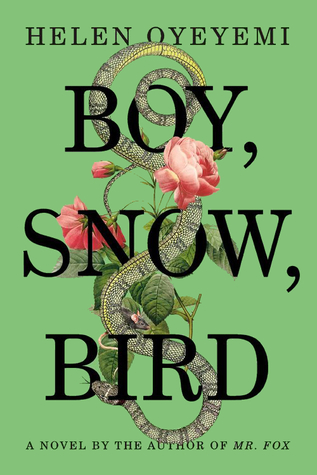
My book club, Women Reading Women, selected the novel Boy, Snow, Bird, by Nigerian-born author Helen Oyeyemi, as our August read.

Hailed by reviewer Anita Felicelli, writing for The Rumpus (March 27, 2014), as “Oyeyemi’s most stunning novel to date,” and lauded by Porochista Khakpourfeb, writing for The New York Times (Feb. 27, 2014), as the product of “a culmination of a young life spent culling dreamscapes,” and the book that the author has been “waiting for” (as in, waiting her whole life to write), I was ready for some literary razzle-dazzle in Boy, Snow, Bird.

Good Cover


You know what kind of razzle-dazzle I mean. Téa Obreht in The Tiger’s Wife. Karen Russell in Swamplandia! Award-winning fiction.

Boy, Snow, Bird occupies the same terrain as those books, the same mental landscape– or the place in literary fiction that we call (wait for it–magical realism (gasp!), which, in commercial fiction, is simply called fantasy.

The distinction in category is made because magical realism (gasp!) faces the world’s ugliness in all its grotesquery (double-gasp!), while fantasy simplifies the good/evil dichotomy to make its plot points more entertaining.

(I mean, seriously– stupid fantasy! Simplifying plot points! How dare you try to make magical realism [gasp!] more entertaining to read. You will never win an award! Never ever!!)

As you might be able to tell from my gasping, I am so over being highbrow about all of this that I’ve permanently smashed my teacups. Consider me sitting in the mud with the fantasy writers, slurping some McDonald’s hot chocolate from a plastic Batman mug.

Can I make it any more clear that I am an ogre? A philistine? A hot-chocolate drinking barbarian?

Barbarians shouldn’t read Boy, Snow, Bird. Let me just put it that way.

Much has been made of this novel. Exuberantly positive critical reviews. “It’s a book about race!” “It’s a book that weaves in elements of dark fairy tales!” “Books that weave in elements of fairy tales are amazing!” “No writer has ever taken a story about race and mixed it with fairy tales! This is spectacular!

This praise is second only to the praise Helen Oyeyemi receives for her cosmopolitan life as an author. “She was born in Nigeria!” “She was raised in London!” “She’s lived in New York, Berlin, Barcelona, Budapest, Prague!” “Now she’s in Paris!” “She’s only 29 years old!” “She wrote her first book as a teenager!” “She could have received an MFA from Columbia, but she didn’t!!” “She turned down the Columbia MFA program!” “This is her fifth and most amazing book yet!!”

Ms. Oyeyemi is a very beautiful young woman–

Helen_Oyeyemi[1]


and I haven’t read her previous four novels. Boy, Snow, Bird is my first exposure to her as an author.

And if I seem like I have a bunch of sour grapes over the fact that I wasn’t born in Nigeria, raised in London, dropped out of the Columbia MFA program, wrote my first novel as a teenager, and all of the rest– well, I’m sorry. This isn’t about sour grapes.

It’s about my confusion.

That a book with the structural problems of Boy, Snow, Bird can still receive so much glowing critical praise.

Because how can I be the only person who read this book and thought, “What in the (bleeping) (bleep)?” by the end?

So let me explain why this book, which is only 308 pages long, and should have taken me, at most, two days to read, ended up consuming a week of my time.

The delay was due to dread. Dread of turning any more pages. A dread that only came into existence because the first 46% of this novel *is* brilliant. That initial 46% is narrated by a young woman named Boy Novak, who grows up with a terrifyingly abusive father called the rat catcher (because he catches rats). Boy is a beautiful white girl, with white-blonde hair, and when she is 20, in 1953, she runs away from the rat catcher (who lives in NYC), gets on a bus, and hops off in a town called Flax Hill, Massachusetts.

Once in Flax Hill, Boy makes some new friends, and she meets Mr. Right, a man named Arturo Whitman. Arturo is a widower, has a gorgeous pale-skinned seven-year-old daughter named Snow, and when he is with Boy, he is a good lover, since she tells us, “the touch of his fingers made me feel like a million bucks” (p. 64).

f18bf0e44d3a6c5a4c45b164fee3f4f7180701abe373a25cddf88c356f58fc2c[1]


What greater testament can I give to how enjoyable the first 46% of Boy, Snow, Bird truly is, than the fact I can quote a cliché that horrible, and still say I was loving the book at that point?

Because I was totally digging this novel through the first 144 pages. I was even thinking, “Oh, I’m so glad my book club chose this one, because the language is so nice and I am just breezing right through this!”

I might slurp my hot chocolate, but I do have some barbarian pride. I love dark fairy tales, and magical realism, and I love books about race, and brutality, and thorny, difficult love.

Yes, please.

I’ll take all of that in my hot chocolate mug. Fill ‘er up.

But then I arrived at the second half of the book.

When Boy Novak Whitman stopped narrating the story.

You see, by the end of Boy’s opening section, we know that right after she married Arturo Whitman, Boy gave birth to a daughter named Bird. (Please don’t worry that I’m spoiling the plot, because this information is on the book jacket.) Boy’s daughter Bird is (quoting the book jacket now) “dark-skinned,” and “exposes the Whitmans as light-skinned African Americans passing for white.”

So Boy reacts by sending Snow, Arturo’s pale-skinned 7-year-old daughter, away. Boy banishes Snow to go and live with a dark-skinned aunt somewhere else, far from Flax Hill.

The next 40% of the novel is narrated by Bird, now 13 years old, writing in her diary.

Her voice is peppy, snooty, tweeny-teen-speak. And what does Bird enjoy doing the most? Why, showing off how oh-so-incredibly smart she is. So much smarter than those dumby-dumb dopey grownups around her. Because Bird talks to spiders! And doesn’t always appear in mirrors! She is magic! She makes up her own fairy tales! And even though it’s only 1967, and plenty of women in America are still overwhelmingly ashamed and ignorant of their female body parts in 1967– not Bird! Because she is so smart! Bird already knows all about stuff like menstruation (duh!) and has a boy her own age who is a perfect gentleman and totally in love with her (of course!) because she’s the prettiest girl in the school! Plus, she writes all this fabulous stuff in her diary! All about how much smarter she is than those doo-wap fuggledy grownups around her. I mean, really! Grownups! Aren’t they so dumb? No one can ever be as smart and precious as Bird!

Am I adequately communicating how much I hated reading Bird’s voice? How childish and annoying I found her? How much reader-me wanted to slap her and scream, “Get out of this book! Get out! I don’t care about you! Where’s Boy? I want your mother back! Bring your mother back NOW!!”

But no.

No amount of screeching on my part could bring Boy back as the narrator. Not until the second half of the book was almost over.

Cutsie little Bird, who is oh so much smarter than those silly old grownups, inspired my dread. Turning pages became agony. And I kept putting the book down, wishing I could just skip book club in August and not finish.

But I finished. And here is why I thought, “What the (bleeping) (bleep)?” by the end.

Bird writes in her diary for many pages (which is boring in and of itself, someone can please shoot me in the head if I start adding long diary passages in any novel I write, thanks).

After all of the diary pages, the reader gets to see Bird actually interacting with people in scene for a bit (her snooty cuteness and tweeny-teen speak in action), and then we get the joy of reading a long (long!!) section of epistolary correspondence between Bird and her banished half-sister, Snow.

Want to know how much I love reading long epistolary correspondence in books?

Not. At. ALL.

So I slogged through the letters. Bird’s snooty cutie-cuteness reached unbearable heights.

And just at the moment when Bird and Snow finally (finally!) stop it with the letter-writing, get together in real life, and hold out some kind of glimmer of hope for the reader that the book might be enjoyable again, might hold the same kind of appeal that the first 46% of the novel displayed–

Narrator switch.

We go back to Boy.

For the final 14% of the novel, we are back in Boy’s head. All the build-up between Bird and Snow gets dropped, a secondary character from the first section of the book takes center stage, and the story turns into some kind of bizarre-o mystery tale, wherein the secondary character comes to Boy to reveal answers to questions no one was even asking throughout the first 86% of the novel, but now those out-of-nowhere questions and revelations are all shared in paragraph-long monologues by this secondary character, and these revelations assume the utmost importance in the final pages.

It’s meant to be this big reveal at the end, like the author is saying, “Oh ho ho, little reader! Bet you had no idea this was coming!” (chuckle, chuckle)

And I wish I could tell the author, “You’re right. I had no idea that was coming. But know what? I don’t care. This big reveal means nothing to me.”

If I’m going to heap praise on a novel– the sort of exuberant praise of a rave review– I have to be able to praise the novel as a whole. Not just the first 46% of it (clichés and all).

Crammed in the final pages, squeezed in like an afterthought for the reader, is the moral of the story– er, fairy tale– that Boy, Snow, Bird is telling. The critics who claim Ms. Oyeyemi isn’t moralizing in this novel are touting complete bullsh**. Ms. Oyeyemi has an obvious message to share, a take-away moral to give the reader about race and our culture’s obsessive love for all things white– and it is this– “we… (… spare ourselves a lot of tedium and terror) by declining to worship.” (p. 275) By declining to worship whiteness, “we beat Them.” (p. 275, same paragraph)

The reason those sentences don’t feel like moralizing is simply because the structure of the book falls apart after Bird takes over as narrator. The mystery element of the novel wasn’t developed in the first half of the story, or in the second 40 percent of the book, so the revelatory ending is a fly ball to right field, after the coach told the hitter to bunt. Boy’s final reflections on race, fleet and fleeting as they are, are like the center-fielder in this scenario: completely unnecessary to the final play of the game. The ball is scooped up in right and thrown in– the center-fielder has nothing to do with it.

As to Helen Oyeyemi, I like reading about cosmopolitan writers, and I hope she writes more books about race. I just hope they have better plots. And no more tweeny-teen speak with cutie-pie narrators. By the end of this novel, I hated Bird, felt cold and dispassionate about Boy, and Snow emerged as the most decent (and believable) human being in the whole story. Even I know, slurping my hot chocolate, that this was probably not what the author intended.

Posted in My Thoughts | Leave a comment

Yellowstone: Part Deux

It’s time for my Awesome Trip to Yellowstone National Park: Part Deux.

If you missed Part I (“Hello, Supervolcano!“) then you can catch up here.

Otherwise, read on for the awesome.

After my husband and I left Firehole Lake, we continued south to Midway Geyser Basin, which is home to Grand Prismatic Spring. This was the view when we stepped out of the car–

100_1957


You can see all the steam from this hot spring rising into the air. There’s a wooden boardwalk (full of people) crossing the Firehole River, leading up and over the hill. The sun was beating down, but the wind was quite chilly and fierce. It was a great time to be in the park.

To the left of the bridge is a place where the spring water feeds into the river–

100_1958


Here’s a much closer picture of the water flowing into the river–

100_1959


Isn’t that rock simply gorgeous? Yellowstone is home to trillions of different microbes, organisms that include bacteria, algae, and archaea.

Archaea (pronounced ar-key-uh) are a category of microbes that may be descended from the earth’s earliest life forms. They are Code Name Cool, as far as I am concerned.

The microbes at Yellowstone are some truly badass microorganisms, as they inhabit water too hot for humans to safely touch, and many thrive in acidic or alkaline environments.

(Side note: this is also the case at the Pit of Death– er, the Berkeley Pit, in Butte, Montana. The Pit of Death is home to an iron-eating microbe, and it’s the only living thing discovered in that water so far. This is water which has a pH of 2.8 or 2.5, and enough arsenic to kill a buffalo with one lick. Um, okay, so I might be exaggerating about the one-lick thing, but there’s a reason it’s called the Pit of Death. True, I am the only one I know of who calls the Berkeley Pit by that moniker, but still. It’s a Pit of Death.)

(Side note 2: there is also an insect that can safely run across the top of the Pit of Death. This is no small thing, as the Pit of Death is as acidic as Coca-Cola, and we all know we clean car batteries and fry unsuspecting garden slugs and rot our teeth with that stuff. But only the iron-eating microbe actually lives in the water. Important distinction.)

Back to Yellowstone– just look at the beauty these minerals and microbes, water and oxidation can create– seriously– holy wow–

100_1960


And the pool for the Grand Prismatic Spring could pass for the Caribbean, like a beach at St. Croix–

100_1961


Here’s another view of the pool, with a rainbow of color around it–

100_1962


And this is the place Where Hats Go to Die

100_1963


There are at least 15 hats in the water in the above picture, the bright pink one being the most obvious, and probably the only one you can see without the picture being blown up. It’s a view of the boardwalk around Grand Prismatic Spring, and because of the wind, children were the ones most likely to lose their headgear, though there were plenty of adults who lost hats as well.

(Side note 3: I left my hat in the car all day. And had a bit of a sunburn by nightfall. Some great new freckles on my shoulders, sigh. But I would have been bummed to lose my hat. Plus, I forgot about sunscreen. Yoda, I am not.)

Here are three more shots of swirly-colorful Grand Prismatic Spring awesomeness–

100_1964


100_1965


100_1966


And the official sign that names this site as the place Where Hats Go to Die:

100_1967


I mean Grand Prismatic Spring, of course. Can you see the gorgeous bright blue color reflecting into that steam?

This picture shows the steam as yellow, orange, blue and green–

100_1968


And here I am at St. Croix again… er, the Grand Prismatic Spring pool, of course–

100_1969


Isn’t Yellowstone amazing? Americans are so lucky we have this wonderland right here in our country, to go and marvel at any time we feel like driving to Wyoming. I think I heard more Hindi, Urdu, German, and French around me than English. An experience that reminded me of hiking to Delicate Arch in Utah before sunset one time. Except that time, there was also a ton of Japanese in the language mix. Though I did see plenty of Japanese tourists in Yellowstone, I just happened to hear less of their language around me, and more of the others.

After our visit to Grand Prismatic, Greg and I drove south once again, and arrived at Yellowstone Central, aka, the facilities that surround Old Faithful. There’s a huge, gi-normous parking lot here, as well as lodges, staff housing, a gas station, gift stores, a grocer… um, yeah. It’s Yellowstone Central.

I don’t know who this woman is, but I snapped this picture in between family photo-ops–

100_1970


She was walking up to usher in the next family to pose for a picture around the Old Faithful Geyser sign. Now she is Super Famous because she’s on my Author Blog like a Rock Star.

Walking past this sign, you stroll down a wide boardwalk, which has a white lump of rock spouting a bit of steam at the end–

100_1971


And that be Old Faithful. Waiting to blow.

I was pretty wowed by all of the people and all of the viewing space. Here’s the view to the left–

100_1972


And the view to the right–

100_1973


And another view to the right, which shows the overflow seating area in the shade of the trees–

100_1975


Greg is in the picture above, but he’s super tiny. He’s sitting on the second section of log-seats past the walkway. The building there is one of the lodges, which also had a large cafeteria and ice cream shop.

Here’s a picture I took about 15 minutes before Old Faithful erupted. I sat on the edge of the boardwalk, and that empty space beside me filled up right after I took this photo. The building behind those people is the Old Faithful Inn, which takes reservations like, two years in advance. It’s only open in the summer.

100_1978


Old Faithful started spouting a bit before the geyser erupted in all of its glory–

100_1980


It’s a really cool sight.

100_1983


Which I watched with at least 5,000 other people that afternoon.

100_1985


100_1986


Within 15 minutes or so (maybe less), all the erupting was done, and people headed out. One of the boardwalk pathways led straight to the Visitor Center in this area of the park–

100_1987


Greg and I walked over to the Old Faithful Inn (this is a view from the back of the lodge)–

100_1989


The Old Faithful Inn has a tower that faces the center of the building, which has a massive fireplace. The tower is called the Crow’s Nest, and an orchestra used to play up there, while people danced or watched the dancing from the first and second floors. In 1959, an earthquake outside the park affected the foundation of the building too much to allow visitors into the Crow’s Nest anymore. I don’t have pictures because my camera does a poor job with interior shots. It’s a Kodak from 2006, and yes, I should replace it, but my uncle gave me this camera as a wedding gift, so I can’t bring myself to trade up. Hence, no Crow’s Nest pictures, sorry.

But I did take a picture of the Yellowstone General Stores (plural)– a combination gift store/grocery/ice cream shop/etc/etc–

100_1996


Greg is standing in the entrance on the right, by the flag. He is Tiny Greg again.

Here is a display of huckleberry products and purple huckleberry-esque stuff inside the store–

100_1998


Greg and I did buy fresh huckleberries from a roadside stand in Montana, and they tasted like blueberries with a bit of cranberry zest. Greg also bought 2 bottles of huckleberry wine. One bottle in Montana, and one from the display pictured above. The Montana bottle was like, $24.99, and the brand on offer in Yellowstone was $14.99. Greg said the Montana brand was a lot better than the wine he bought here.

After our visit to see Old Faithful, we left Yellowstone Central and drove through the southern part of the figure-8 loop through the park. We passed the south entrance, then headed north again, around Yellowstone Lake. Yellowstone Lake is the largest high-elevation lake (above 7,000 feet) in North America. I didn’t take a picture of it because I am lame.

Instead, I took a picture of the grassland around the lake, because just look at this green!! 

100_1999


And that’s the display in my old camera– it was much more brilliant than this photo can show.

There were some bison scattered around in this area, munching. I didn’t stop to take pictures of them because 1.) I’ve seen bison up close before, and petted tame ones kept as pets, and 2.) there were plenty of other people taking pictures of them, and I was like, yeah, I’m good.

We drove to the Grand Canyon of the Yellowstone River, and I took this picture of the falls–

100_2002


This is a HUGE waterfall. Even as far away as I was, taking this picture, the air was thunderous.

A little farther away, I took this picture of the canyon–

100_2003


Here’s another waterfall picture–

100_2005


Some very cool rock in the canyon–

100_2007


And then I walked back to the car, and just before I hopped back in Queen Elizabeth, I took a selfie–

100_2009


I don’t know why I didn’t think to take a selfie in front of the waterfall or the canyon. I think I was a little tired from running the trails and the boardwalks trying to see everything, despite the delays made by the crowds and the issues with parking. As you can see from the empty parking spaces behind me, traffic was far less of a problem in the late afternoon than during the morning and midday. But while there might be a plethora of open parking spaces here, the final viewpoint I visited was still extremely crowded, and the loudest access point I visited. People were really noisy there.

When we left Yellowstone Park, we drove south through the Grand Tetons and into Jackson Hole.

I’d never been to Jackson, Wyoming before, and I was surprised to discover it’s like a bigger, cleaner, spiffier version of Aspen. Aspen has a bit of grunginess to it (it’s far more upscale than Telluride, but still grungy, despite the drastic differences in real estate prices)– but Jackson, compared to Aspen, was all polish and gleam. Where I live in Durango, I’m never more than ten feet away from someone who has recently moved here from California, and I hear this a lot, “Well, we moved to Durango instead of Jackson Hole because Jesus Christ! The snow Jackson gets! Do you have any idea how much more snow they have there?”

And I’m like, “Well, it is farther north than Durango…” (That’s if I even answer at all. Most of the time, I just stand there, smiling and nodding, while some recent transplant to Colorado rains down upon me their newfound wisdom about mountain snowfall, like I live in a drainage ditch in south Texas, and know nothing of such things.)

I don’t know what it is about Californians who leave California for Rocky Mountain locales, but they frequently get very vocal about snow. And they like to pontificate. Loudly.

I should note that my friend Laurel, who moved here from California decades ago, has never once given me an earful about snowfall. (Thank God.) Nor has any Californian who has lived in Colorado since 1995. It seems to be the post-2000 Sunshine State diaspora that acts like this. I find the conversation beyond tedious. If I ever write a skit for the Durango Follies, a comedy show that’s put on every February for SnowDown here, I’m going to feature character-me in the skit, and I’ll let character-me say the sort of things I never say to the snow-complaining/snow-pontificating members of this diaspora in real life. Because the Durango Follies are written and performed for Durangatangs, and the best humor is always the stuff everyone else is already thinking, but doesn’t say either.

Greg and I didn’t stay the night in Jackson because everything was booked. We drove way out to the middle of nowhere, and camped in a little town called Pinedale, where the temperature dropped to below 40 that night. It was our last night on the road, and I slept great.

Thanks for reading about my trip to Yellowstone! I hope you enjoyed the pictures!

Posted in My Thoughts | Leave a comment

Hello, Supervolcano! My Trip to Yellowstone National Park (Part I)

On Thursday, July 24, my husband and I visited Yellowstone National Park. He had been there 3 times before (the last time being in 1998). I’d never visited the park.

As a side note, July and August are the busiest months at Yellowstone (and most national parks)– and you should be prepared for lots and lots of people around you if you visit Yellowstone during peak season. It’s very difficult to find parking spaces, and while I’ve been in parks during peak season before, I’ve never seen anything like the massive crowds in Yellowstone in July. Neither had Greg. It was definitely a learning experience for both of us.

Most people are aware that Yellowstone encompasses the northwest corner of Wyoming– (though I’m sure there are folks who happily spend their lives never knowing which state this park is in, much less what part of the state it is in, but so it goes). Greg and I entered the park from the north entrance, just outside Gardiner, Montana, which meant that we passed through the Roosevelt Arch– and here is my Prius (Queen Elizabeth)– driving into Yellowstone Park–

100_1920


The inscription above the arch reads: “For the benefit and enjoyment of the people

Which could also read: “You can be boiled alive here, it’s awesome”

Because Yellowstone Park is the site of a supervolcano, and that is what makes this place so incredibly fantastic! A supervolcano is a volcano with an eruption size thousands of times larger than “a normal volcano.” Some volcanos blow out their guts (their magma chambers) so quickly (and spew their guts so far away) that the land around the volcano collapses into the emptied magma chamber, forming a depressed area known as a caldera.

In volcano years, the Yellowstone Caldera is very young, only 640,000 years old. There are actually 3 major supereruptions that have formed calderas in Yellowstone over the last 2.4 million years (and other eruptions that are responsible for smaller calderas and land formations in and around the park). Some scientists have put forward the idea that the Yellowstone supervolcano could blow again at any second, leading to Facebook memes like this one–

10488200_742514562459114_8523451280929784682_n[1]


Other scientists say that Yellowstone’s supervolcano is in no danger of blowing again any time soon, and that those other scientists are being a bunch of alarmist hobos trying to get celebrity status with doomsday predictions.

Or something like that.

I fall into the camp of believing the Yellowstone supervolcano is not an immediate threat, and it seems that the scientific community largely agrees with that view.

But that doesn’t change the fact that Yellowstone is an awesome park to visit– because the land here is very much alive. Alive and moving. There are more active geysers in Yellowstone than anywhere else in the world. And it’s littered with places where the ground layer is so thin, you can break through the surface and land in scalding water. (Definitely have to watch where you step in this park.)

Along with geysers, there are hot springs, mudpots, fumaroles, travertine terraces, blankets of microbes that thrive in the heat, thousands of earthquakes that take place here every year (and Yellowstone is extremely sensitive to earthquakes in other places, even thousands of miles away)– this land is always moving, always shifting and raising and falling and changing– in short, Yellowstone is living, breathing geography. It is the earth exposed. Like watching planet porn. This is the place where clothes have come off, and earth is like, “Here I am, people! You wanna see what I got? Watch this!”

And it’s like, oh mama, yeah, I wanna be watchin’ that, mm-hmm, this is hot– as in, supervolcano-hot.

Over 3 million people visit Yellowstone to gawk at planet porn every year. This summer, I was one of them, and it’s pretty damn addictive.

The northern part of the park is fairly barren (maybe you can see the complete lack of trees in my Roosevelt Arch picture?)– but as you drive in, pine trees eventually appear.

There’s a park headquarters shortly after the northern entrance, complete with a gas station, a large campground, even a huge lodge– the Mammoth Hot Springs Hotel & Cabins–

100_1927


There are a lot of gas stations, grocery stores, staff housing, and campgrounds in Yellowstone (to give a partial list of the variety of structures that exist inside this massive park). For example, down the road from the Mammoth Hot Springs Hotel was a bunch of houses and old-timey buildings, complete with cows (female elk) and their calves either eating or sleeping–

100_1928


100_1930


Greg was all, “Do NOT get close to those cows!!” and I said, “Um, last time I checked, I still had a brain.” (Thanks.)

No offense to the people who get mauled, gored, and killed by wildlife in Yellowstone each year– but I find the cartoon warning pictures the park passes out on bright yellow sheets of paper (in copious numbers) pretty funny.

I mean, it’s not funny that people get hurt. That’s not what I find funny. It’s the cartoon pictures depicting people being gored that strike me as funny. And the fact that people have to be told (in large, childish print, and on copious numbers of identical fliers), that buffalo and elk “are very big and can sprint three times faster than you can run.”

Why is this so funny to me?

It’s like if I flew into LaGuardia for a shopping trip in Manhattan, and before leaving the airport, I was given several bright sheets of paper that all said, “Going for a walk late at night while flashing large wads of cash and jewelry invites unwanted attention, and might provoke a mugging,” complete with a cartoon picture of a woman in a fur coat, loaded with diamonds, clutching huge stacks of cash in both hands, being held at gunpoint by someone from a Steven Seagal movie.

Even one such flier would make me laugh. But to be handed three of them? Plus a full-color pamphlet about “muggers” or “the dangers of muggers” (Yellowstone’s equivalent of their full-color bear pamphlet), not to mention an “events and activities” newspaper with warnings about muggers on every other page– ??

Seriously, I’d just be laughing.

I mean, I wouldn’t be laughing because people in cities get mugged. Just the fact that people would be handed so many fliers and cartoon pictures and pamphlets and newspaper warnings about the danger of a possible mugging. That’s what I would find so bizarre.

100_2017


Every time I look at this cartoon picture of a guy being stabbed in the kidney by a buffalo (with an obvious “Ow!” expression on his face, while his camera and baseball cap go flying)– a cartoon I was given on three different bright yellow fliers, along with my park receipt, events paper, and bear pamphlet– I just feel my internal absurdity-meter rack up a few notches.

And then I watch something like this “bison fury” video on YouTube (running time one minute, 26 seconds, which you can watch here)–

which shows a family walking up to a buffalo in Yellowstone Park–

being filmed by some other guy (not in the family) who is just chuckling as he watches–

and he doesn’t warn these children and adults of the dangers at all, because he is chuckling and enjoying the anticipation of the attack he is sure will happen–

and then the animal charges, people run, the bison chases after a small boy for a while, and when no one is hurt, everyone is just laughing, like “haha, wasn’t that funny? What a great bit of excitement we just had!”

And I am like, You people are the reason I received 3 yellow fliers, plus a bear pamphlet warning guide, plus everything else. They are the woman strolling alone through a bad section of town, fanning herself with a wad of hundreds, fingering her diamond necklace, and pouting in her best Marilyn Monroe voice, “Anyone know where I can buy a drink around here?”

But anyway, back to my trip.

I took several pictures at the Mammoth Hot Springs Terrace. This travertine buried/killed the vegetation along the landscape–

100_1922


which is so ghostly and desolate and moonlike in its beauty.

100_1923


There were other cool formations here–

100_1924


It’s just amazing what minerals and heat and oxidation and microbes are capable of creating–

100_1925


Greg took a seat for a moment–

100_1926


and then we finished this little boardwalk loop in the north of the park, and hopped back in Queen Elizabeth. Yellowstone has a large figure-8 road that loops through the park, which we drove in a large, backward-S direction, making our way toward the south entrance. The northern part of the park doesn’t have as many trees as the southern part–

100_1931


But when you watch videos of wolves hunting elk and bison in Yellowstone, this is the area of the park where they thrive in the winter–

100_1933


This is the view beside Tower Falls (which is right by the road, in the northeast side of the figure-8 loop)–

100_1934


A wildfire hit Yellowstone in 1988 (and other years, but that fire gets cited the most)– so you can see a lot of dead trees on the drive–

100_1936


Sometimes I thought Yellowstone could be called Dead Tree Park instead.

Here’s an area in the park called the Artists Paintpots, which is a lovely little stroll around a number of interesting geysers and bubbling places–

100_1938


Here’s the view of that area from the upper trail (you can see the long wooden boardwalk, and the middle-left of the picture holds the small parking lot that services this location, you can just barely see a bit of white from the vehicles)–

100_1939


Greg and I couldn’t find a parking place at the Norris Geyser Basin, so I missed seeing that area (bummer!)– but here is a picture of Gibbons Falls (located in the top of the southwest quardrant of that figure-8 loop)–

100_1941


My next picture is one of the most Truly Magical sights I witnessed during my time in the park– and that was the image of all these families swimming together beneath Firehole Falls–

100_1943


What my photograph can’t capture is the sound of pure happiness that twinkled through the air– the sweet noise of children of all ages splashing and playing with their parents and family members, couples showing off for each other by leaping from the rocks, and the pine-scented smell of the wind. Up the road slightly was a much different view of this swimming area– as you head south, you can see that there are these beautiful, steep rocks all around this chasm of river water– and I didn’t ask Greg to stop because I was just breathless by the beauty and joy of all these people swimming in the Firehole River. If I ever return to Yellowstone in peak season, it will be to visit this swimming area and jump in the water.

One thing I never expected was how flat the top of the Yellowstone Caldera is– how many wide open spaces exist in the park–

100_1944


And how much vegetation is killed because of the geysers, hot springs, mudpots, steam vents, and other geothermal features of the park–

100_1945


The amazing geography of Yellowstone is both killer and life-giver, bringing death and rebirth as quickly as wildfire. In the picture above, you might be able to see the white bottoms of the tree trunks, how they have absorbed the mineral content of the land, so much that it stained their dead bark.

In places like the spring below, stepping off the boardwalk can land you in scalding water–

100_1946


In general, herds of bison and elk avoid dangerous places, but there are stories of gasses erupting from the earth and killing them, as well as being caught in the mud or scalded by springs and geysers, the same way people can suffer such incidents.

The colors around the springs are incredibly gorgeous– and here is some of that infamous “yellow stone” in the park–

100_1947


In the picture below, this area held large holes in the ground releasing gas with a ROAR– this site was LOUD, really loud! It was totally awesome!

100_1949


More geysers and springs! Such a wonderland of hot water and earthworks–

100_1950


Here was a sign posted at the Great Fountain Geyser, including estimated eruption times–

100_1953


And here is the Great Fountain Geyser, though I didn’t stay to see it blow (that would have been several hours of waiting)–

100_1954


I’ll close with a picture of Firehole Lake, which has these beautiful reds and browns swirling through the blue–

100_1956


Now, because this blog post is winning my personal website contest of Longest Blog EVER, I’m going to save Grand Prismatic and Old Faithful for Part II of this post. So I hope you’ll tune in later for more!

Posted in My Thoughts | 2 Comments